
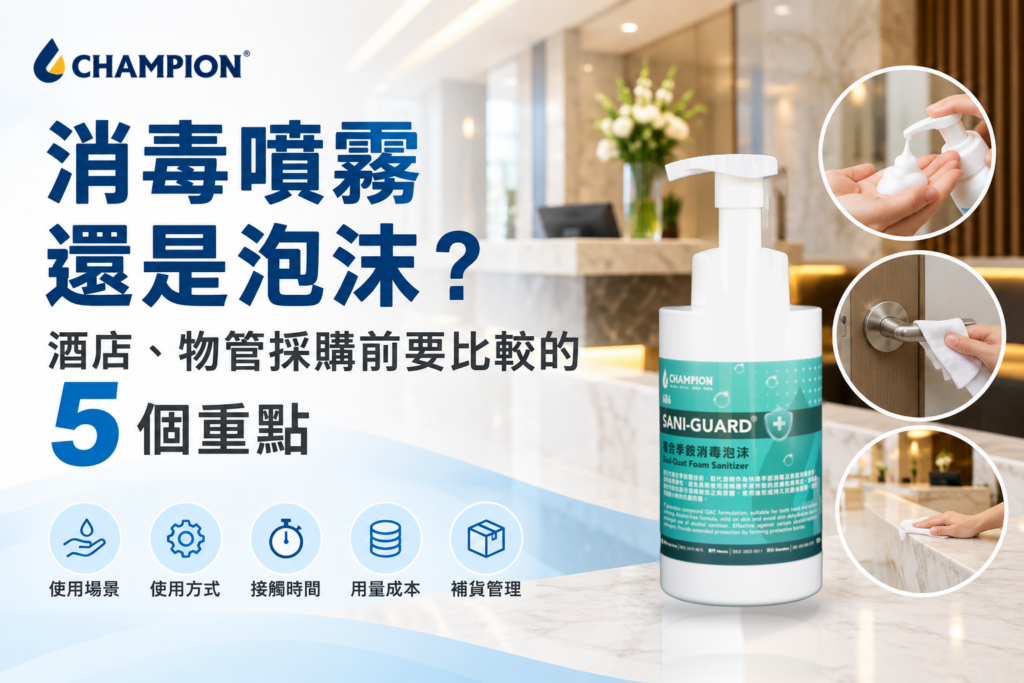
Which is more suitable for hotels and property management: disinfectant spray or foam? First, clarify whether it's hand disinfection at the reception area or surface disinfection such as door handles and handrails. Then compare the usage methods, contact time, and total cost. Choosing the right products and accessories will transform the procurement list into a daily routine that is easy to implement on the front lines and easy to replenish at various locations.
This article breaks down the selection process from five key procurement considerations and introduces how 686 SANI-GUARD ready-to-use disinfectant foam can be used in hotel and property management scenarios. Spray and foam are application methods, not differences in disinfection efficacy; procurement decisions should consider product formulation, intended use, and on-site operation simultaneously.
If you need to plan the supplies for different areas together, you can refer to our [reference].Hotel and accommodation cleaning solutionsandProperty Management Cleaning and Sanitation SolutionsThe supplies in the lobby, public facilities, and back-of-house areas are configured according to their intended use.
Key Takeaways
- First, distinguish between the intended use on hands, general hard surfaces, and food contact surfaces, and then compare disinfectant sprays or foams.
- By comparing the specified usage, contact time, and accessories, clear arrangements are made for both visitor retrieval and cleaning team operation.
- Compare the total cost based on actual usage, operating hours, and replenishment expenses, not just the selling price per bottle.
Table of Contents
- How to choose between disinfectant spray and foam? First, classify them according to the usage scenario.
- How to use it: How to integrate it with the hotel and property management workflow?
- Disinfectant contact time: A key question to ask before purchasing
- Cost of use: How to compare actual usage expenses?
- Replenishment Arrangements: How to achieve unified procurement and management across multiple locations?
- 686 SANI-GUARD: Application of disinfectant foam in hotels and property management
- Frequently Asked Questions
- Inquire about hotel and property management disinfection supplies solutions
I. How to choose between disinfectant spray and foam? First, classify them according to the usage scenario.
The most common procurement mistake made by hotel and property management teams is treating all "disinfection products" as the same category of supplies. Reception areas need hand sanitizers that visitors can easily take themselves; cleaning carts need surface disinfection products suitable for materials like door handles and handrails. Categorizing by "who uses it, where it's used, and what it's used for" allows for the proper arrangement of products, pump heads or nozzles, operating instructions, and replenishment responsibilities.
Hands, hard surfaces, and food contact surfaces should be checked separately.
Disinfectants used for door handles or countertops should not be used as hand sanitizers simply because they are labeled "disinfectant." Even if a product lists both hand and surface uses, each should be used according to its respective instructions. For restaurant tables, preparation counters, and other food contact surfaces, the applicable scope and post-use treatment requirements need to be confirmed separately.[1][3]
For stainless steel, plastic, coated surfaces, and electronic device housings, it is advisable to confirm their suitability separately before conducting small-scale trials. Record the materials and intended use locations in the purchase order for future reference when adding new locations or replacing supplies.
Disinfectant Sprays and Foams: Usage and Trial Decision Form
| Use cases/needs | First confirm the product conditions | On-site trial and procurement judgment |
|---|---|---|
| Hand sanitizing at the reception desk | Verify the intended use, dosage, and original dispensing device; surface products should not be used directly as hand sanitizers. | Trial the product according to the label dosage, and record the ease of use, leakage, and replenishment time. |
| Door handle/handrail | Verify the suitability of the material, the specified application method, and the contact time. | Tested on the same material and within the same area to confirm that the coverage and wet contact time can be completed as labeled. |
| Food contact surfaces | Verify the suitability for food contact surfaces, as well as the requirements for cleaning, rinsing, and subsequent treatment. | Only compare products that are suitable for the intended use, and conduct trial runs and record the procedures as specified; do not select products solely based on dosage form. |
| Cost comparison | The same purpose, processing scope, number of times, and recording period are fixed. | Fill out the cost comparison table below, listing products, labor hours, parts, and delivery, and compare them on the same basis. |
| Multi-site replenishment | Check the packaging, original accessories, replenishment specifications, and delivery arrangements. | Record the actual consumption, replenishment time, and inventory at each point of use; arrange replenishment according to the delivery cycle. |
II. Usage: How to integrate with hotel and property management workflows?
Visitor access points should prioritize ease of use, clear purpose, and availability for replenishment; cleaning teams, on the other hand, need fixed processing areas, tools, and handover procedures. Separating these two processes makes it easier to compare whether supplies truly meet on-site needs.
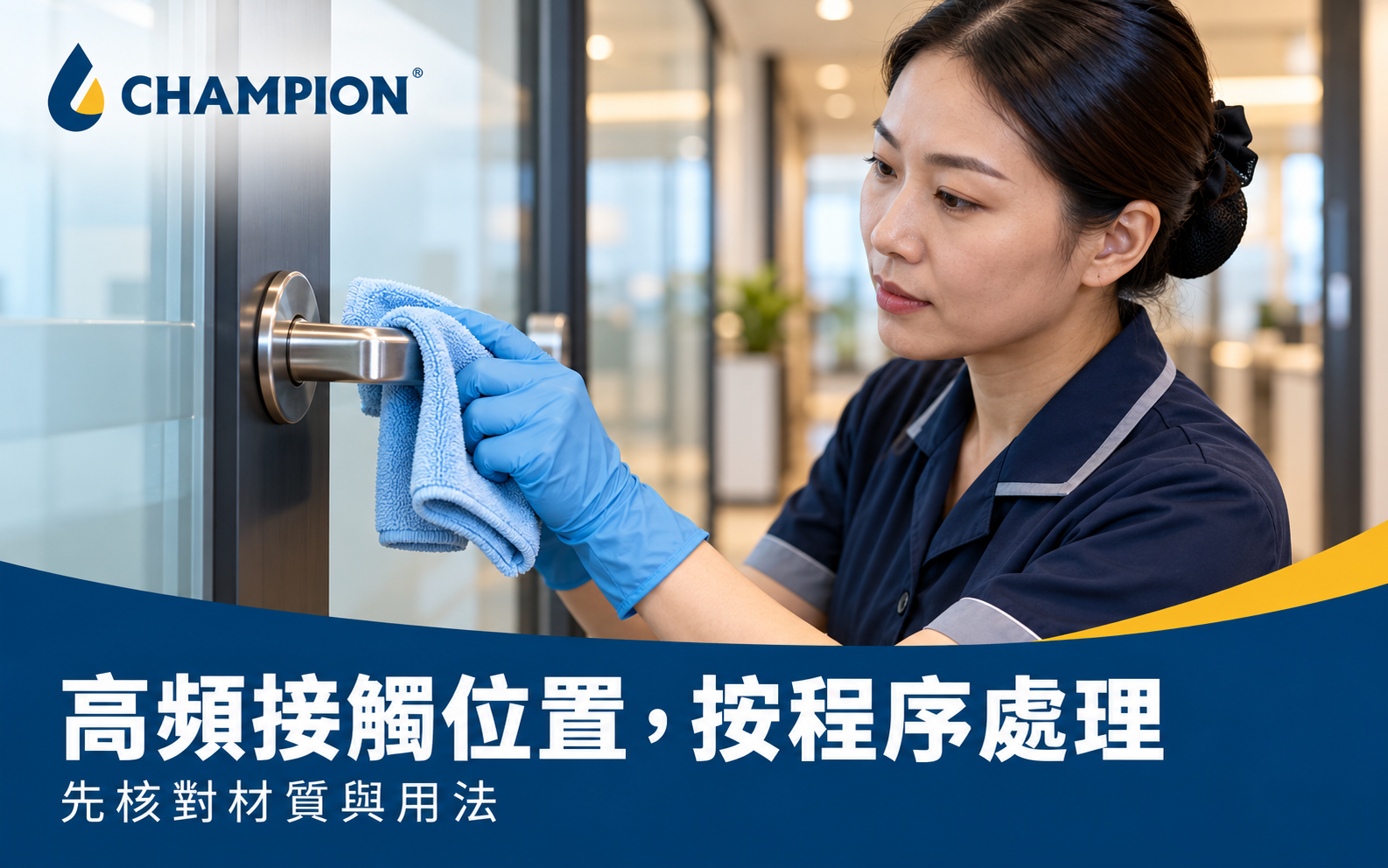
The Hong Kong Centre for Health Protection states that routine spraying of disinfectant on indoor surfaces is generally not recommended, and that wiping with a cloth or wipe soaked in disinfectant is preferred. Therefore, when purchasing spray bottle products, the actual application method should be specified, rather than assuming that "having a nozzle" means it can be sprayed indiscriminately into any space or on any surface.[1]
During the trial, record the frontline operations as well.
It is recommended to first select a representative reception area or cleaning area, have the staff who actually use it pilot the program, and record the following items:
- Visitor usage points: Are the usage labels clearly displayed? Is the bottle or device easily accessible? Who is responsible for inspection and replenishment?
- Cleaning work area: Do employees know the designated usage methods? Are the cleaning cloths and tools used managed according to area?
- Shift handover arrangements: Which locations have been processed, which require restocking or follow-up, and are there any simple records?
- Ease of use: Is the pump head or nozzle easy to use? Is the bottle stable? Is refilling convenient?
- Material confirmation: Is it necessary for the supplier or equipment manager to confirm the suitability first?
Trial records can focus on whether the retrieval process is smooth, whether the specified steps are easy to complete, and how long it takes to replenish. Ease of use and disinfection effectiveness data are compared separately, allowing procurement to consider both frontline experience and usage requirements.
III. Disinfectant Contact Time: A Key Question to Ask Before Purchasing
For surface disinfection, allow the contact time indicated on the product label and keep the surface moist for the specified time as required. Ask about dilution, application, and post-treatment methods before purchasing to incorporate the disinfection procedure into the cleaning shift, rather than just scheduling "spray and wipe dry immediately".[2]
For hotel public facilities that require rapid turnover, the following questions should be asked during procurement:
- How much time should be allowed to complete one processing cycle?
- Does the product need to be diluted or rinsed?
- Can the frontline cleaning be completed within the existing cleaning shifts?
- Are there any specific material, ventilation, or storage requirements?
- Do the efficacy test data correspond to the actual usage concentration and exposure time?
Before purchasing, clarify the intended use, operation, and effectiveness information all at once.
Checklist for Procurement Documents of Disinfection Supplies
| material | Primary use | Confirmation is required during procurement. |
|---|---|---|
| Product Labels/Technical Information | Understand the intended use, concentration, contact time, and operating methods. | Does the document correspond to the purchased model, formula, and usage scenario? |
| Safety Data Sheet (SDS) | Understand protection, storage, first aid, and incompatible substances. | Does the front line have the necessary operating and storage conditions? |
| Efficacy test data | Understand the test results for the target microorganism under specified conditions. | Whether the test method, concentration, and contact time are consistent with the intended use. |
| On-site trial record | Understand the configuration, usage, operation, and replenishment performance. | Can it be coordinated with the venue procedures? Appearance should not be used as a substitute for efficacy testing. |
If the work involves food contact surfaces, the appropriate cleaning and disinfection procedures should be followed. The Centre for Food Safety guidelines list the removal of residues, washing, rinsing, disinfection, and drying as relevant procedures, and the label instructions must be followed when using disinfection products.[3] The procedures for different areas should be explained separately during training to avoid applying the same set of operations to all locations.
IV. Usage Costs: How to compare actual usage expenses?
When comparing commercial disinfection products, it's helpful to first standardize the specifications and usage, and then consider how much product is needed to complete each designated task. The dispensing volume of different pump heads, the operating methods of employees, and the scope of their work will all affect consumption; focusing solely on the price per bottle can easily overlook the number of uses and the time required for replenishment.
Usage estimation: First count the number of bottles, then compare the total cost.
Hypothetical usage example: 10 usage points, each point consuming 1 500ml bottle of product per week, calculated over 4 weeks, totaling 40 bottles per month, or 20 liters. This is an inventory estimation example, not a recommended operating dosage; actual procurement should be adjusted based on usage records at each site and delivery cycles.
- Average product cost per task = Actual product cost consumed during the period ÷ Number of times the specified task is completed.
- Monthly total cost = Product consumption cost + Parts/consumables cost + Replenishment and operation labor cost + Delivery cost.
Labor costs can be estimated as "actual operating hours × hourly labor cost". Ready-to-use products can eliminate the on-site dilution step, but whether overall labor time is saved should still be compared with the time for picking, wiping and replenishing; the freed-up labor time can be reallocated, which does not necessarily mean that salary expenses will decrease.
When comparing quotes, list the product, equipment, replacement parts, delivery, and support services separately. Comparing quotes with the same scope of work and label usage will reveal whether the difference stems from product consumption, accessories, or routine management work.
A cost comparison table can be filled out: based on actual measurements of the same work scope.
Before filling out the form, clarify the intended use, scope of processing, number of times the work will be completed, and the recording period. Also, confirm that both solutions comply with the corresponding label usage and contact time. The blank form is for on-site recording and is not a suggested usage or a cost-saving commitment. The total cost includes the product, labor hours, accessories, and delivery. The average cost per transaction must be calculated using the number of transactions completed within the same recording period.
| Item to compare | Option A / Actual Measurement Filling | Option B / Actual Measurement Filling |
|---|---|---|
| Product/Dosage Form and Instructions for Use | ________________ | ________________ |
| Record period / Number of work completed | From ____ to ____ / ____ times | From ____ to ____ / ____ times |
| Actual consumption / Product consumption cost | ____ ml / HK$ ____ | ____ ml / HK$ ____ |
| Supplemental and operational labor costs | ____ hours × HK$____ / hour = HK$____ | ____ hours × HK$____ / hour = HK$____ |
| Accessory/Consumable Costs | HK$____ | HK$____ |
| Delivery and other charges (please specify items) | HK$____/________ | HK$____/________ |
| Total cost during the recording period | HK$____ | HK$____ |
| Average total cost per task completed | Total cost ÷ Number of completions = HK$____ | Total cost ÷ Number of completions = HK$____ |

V. Replenishment Arrangements: How to manage procurement and inventory across multiple locations?
When hotel groups or property management companies manage multiple venues, they can standardize procurement data and replenishment processes, and then allocate inventory according to the foot traffic of each venue. This allows for centralized understanding of usage and facilitates tracking the reasons for a sudden increase in consumption at a particular location.
- Product list: Record the model, packaging specifications, applicable locations, and the latest usage guidelines.
- Inventory arrangement: Set up replenishment points based on average consumption, delivery time and peak season needs, and pay attention to expiration dates.
- Division of responsibilities: Designate personnel for inspection, replenishment, training, and liaison with suppliers to avoid different people handling the same tasks separately.
- Anomaly tracking: Record leaks, pump head malfunctions, misuse or changes in dosage, and arrange for inspection and correction.
Replenishment points can be estimated based on "average daily consumption × delivery days + reserve quantity", and then adjusted according to traffic flow, activities, and expiration dates. When products or pump heads are replaced, front-line instructions are updated simultaneously to ensure that different replacements use the same set of operations.
686 SANI-GUARD: Application of disinfectant foam in hotels and property management

The hotel reception area needs handwashing supplies that are easily accessible to visitors, and frequently touched surfaces such as door handles and handrails should also be disinfected in conjunction with routine cleaning. CHAMPION 686 SANI-GUARD Dual-Quat Foam Sanitizer: no dilution is required. Use the original foam pump for rapid sanitising of hands and designated hard surfaces.[4][5]
686 uses an alcohol-free compound quaternary ammonium formula that is gentle, non-corrosive, and non-irritating, and provides long-lasting antibacterial protection, meeting the daily hand and surface disinfection needs of hotels and property management companies.[4][5] Follow the product label’s respective instructions for hand use and surface wiping.
For teams managing multiple usage points, the ready-to-use design eliminates the need for on-site preparation; the 500ml bottles and 6 bottles per box also make it easy to arrange procurement and replenishment according to the actual consumption at each site, making it easier for frontline operations and inventory management to coordinate.[4]
We can assist in organizing product usage, operating accessories, and corporate procurement needs based on locations such as reception areas, door handles, and handrails. First, record usage and employee feedback at representative usage points, then expand suitable configurations to other areas, integrating product selection with daily management.
Inquire about venue configuration and corporate procurement for item 686.
Frequently Asked Questions
Is disinfectant foam always more effective than disinfectant spray?
You cannot judge solely based on the dosage form. Sprays and foams are application methods; disinfection performance requires examining the formulation, target microorganisms, concentration, and contact time. When purchasing, first confirm whether the product can handle the intended purpose, then compare the operation and dosage.
What are the uses of quaternary ammonium salts?
Quaternary ammonium salts are a type of ingredient used in some disinfectant products. 686 SANI-GUARD uses a compound quaternary ammonium formula and can be used on hands and hard surfaces that come into contact with many people, as specified in the instructions. When purchasing other formulas, you should also check the label for the intended use.[4]
Can the same hand sanitizer be used on both hands and countertops?
Arrangements can only be made if the product information clearly lists the intended use and the product is used according to the instructions. If the countertop will come into contact with food, the requirements for food contact surfaces must be checked separately; a label indicating that it can be used on general hard surfaces does not mean that it is suitable for all food handling locations.
What should hotels and property management companies pay attention to when purchasing alcohol-free disinfection products?
First, determine whether it's intended for use on hands or surfaces, then check the contact time, operating instructions, and safety information. Alcohol-free is a characteristic of the formula; however, when purchasing, still consider storage and usage requirements, and follow the label instructions carefully. Do not mix cleaning products yourself.[1]
Can the foam pump head be replaced with a regular nozzle?
It is not advisable to assume that the two are interchangeable. The pump head or nozzle will affect the application method and liquid output. Before replacing, you should confirm with the supplier whether the device is suitable and whether the operating instructions need to be adjusted.
Which disinfectant spray is better? How should hotels and property management companies choose?
First, select products based on their intended use and surface material, then compare contact time, on-site usage, and replenishment arrangements. During procurement, verify product labels and technical data to ensure frontline staff can operate according to the specified methods.[1] By selecting representative locations for trial use and recording consumption and operational feedback, it becomes easier to determine whether the product meets the team's needs.
Are disinfectant sprayers useful? Are they suitable for daily use in hotel lobbies or shopping malls?
Hotels and shopping malls should not use misting spraying as a routine surface disinfection method. The Centre for Health Protection recommends that indoor surfaces be disinfected by wiping with a cloth or wipes soaked in disinfectant, and that the contact time be completed according to the product requirements.[1] When purchasing, it is necessary to distinguish the purpose of spray bottles, foam pumps and atomizers, and not to repurpose existing disinfectant for atomizing equipment.
Inquire about hotel and property management disinfection supplies solutions
CHAMPION supports hotels, shopping malls, and property management teams in Hong Kong Island, Kowloon, and the New Territories in selecting professional cleaning and disinfection products. Simply provide us with the location, quantity, and current consumption levels, and we will discuss the 686 product configuration, corporate procurement, and replenishment arrangements. Even without complete data, we can start with on-site needs.
Query 686: Enterprise Procurement and Site Configuration WhatsApp Instant Inquiry
Further Reading
- A comprehensive comparison of disinfection methods for commercial spaces
- Standardized Hygiene in Property Management: From Cleaning and Disinfection to Odor Management
Source of information
[1] Hong Kong Centre for Health Protection: Frequently Asked Questions about COVID-19Question 17: "What precautions should be taken when using disinfectants?"
[2] U.S. Environmental Protection Agency:Selected EPA-Registered DisinfectantsProduct label and contact time instructions (general reading reference, not a 686 certification statement).
[3] Hong Kong Centre for Food Safety:Cleaning and sanitization(Cleaning and disinfection).
[4] CHAMPION:686 SANI-GUARD Dual-Quat Foam Sanitizer product information.