
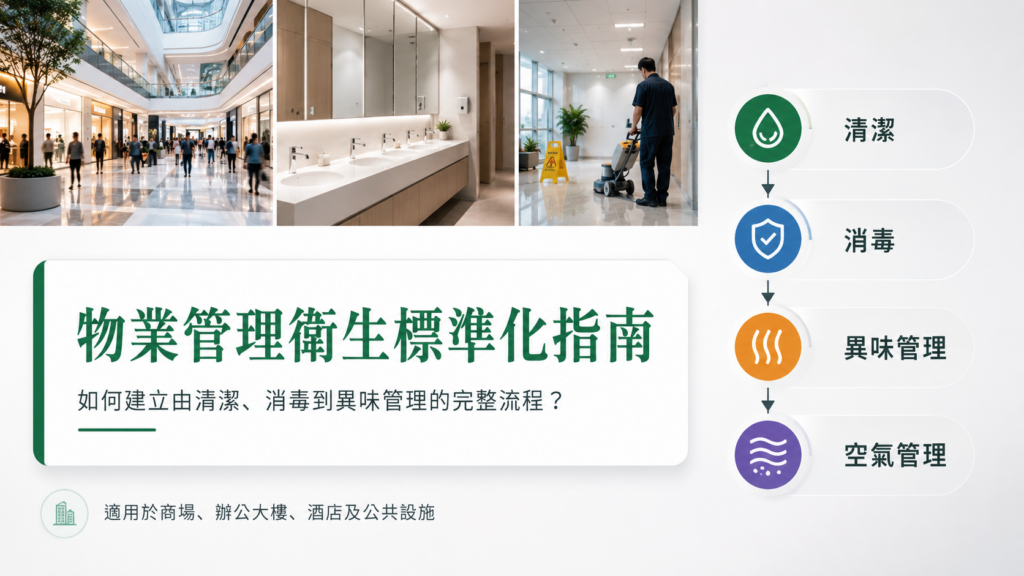
The Property Hygiene Management Guidelines aim to elevate routine cleaning into a standardised management practice, improving operational efficiency and the user experience across shopping malls, office buildings, hotels and public facilities.
As the use of public spaces increases, management must extend beyond surface cleanliness to cover high-touch point disinfection, washroom maintenance, drainage and odour control, and indoor air quality.
Increasing cleaning only after complaints are received usually provides temporary relief and cannot maintain consistent standards. Property management teams therefore need practical, traceable hygiene processes built around prevention, monitoring and ongoing maintenance.
Key Takeaways
Property hygiene management needs to be upgraded from simple cleaning to comprehensive management, including disinfection of public spaces, maintenance of restrooms, odor control, drainage management and air quality improvement.
By establishing standardized hygiene procedures and appropriate solutions, property management teams can reduce the recurrence of problems, improve management efficiency, and enhance users' experience of the public environment.
📖 Table of Contents
- How should property hygiene management guidelines address odor and environmental risks?
- Why does property hygiene management need to be standardized?
- From Cleaning to Hygiene Management
- Establish a four-tier property hygiene management process
- How to effectively manage disinfection in public spaces?
- How can restroom management shift from problem-solving to prevention?
- Champion Property Hygiene Management Solution
How should property hygiene management guidelines address odor and environmental risks?
Hong Kong has a high building density, with many shopping malls, office buildings, hotels, and residences located in mixed-use buildings, sharing plumbing, air conditioning, and logistical facilities. Any accumulation of waste, drainage, or ventilation problems in any of these areas can cause odors and hygiene risks to spread to other spaces.
Related risks may occur in locations such as garbage rooms, grease traps, restrooms, parking lots, smoking areas, and restaurant back-of-house areas, and may affect resident satisfaction, tenants' willingness to renew leases, and the property's image.
With limited manpower and budget, the property team should first identify risks and causes according to the scenario, and then allocate resources for cleaning, disinfection, source treatment and air management to avoid resource misallocation or only superficial treatment.
Common high-risk scenarios include:
| High-risk scenarios | Common sources of odor or hygiene |
|---|---|
| restrooms/public toilets | Urine, ammonia, drain and mould odours, compounded by poor ventilation |
| garbage room | Food waste, garbage residue, sewage accumulation, and bacterial growth |
| Grease trap/sewage drain | Greasy wastewater, grease and scale build-up, drain odours and hydrogen sulphide |
| Smoking area | Smoke smell, lingering odors in the air, and insufficient ventilation |
| Restaurant Back-of-House Areas | Grease traps, drains, kitchen waste and grease wastewater |
| Hotel Room | Smoke, mould, stale air and odours trapped in fabrics |
| Parking lot/garbage collection point | Vehicle exhaust, garbage residue, sewage accumulation, and insufficient ventilation |
After establishing a scenario list, the property management team can prioritize inspections and maintenance based on risk level, complaint frequency, and on-site resources.
Why does property hygiene management need to be standardized?
Property management involves various environments, including shopping mall public areas, office buildings, hotel facilities, public restrooms, and back-office spaces.
Different venues face different hygiene challenges. Shopping malls need to address the public health needs arising from large crowds; hotels need to maintain a positive customer experience; and office buildings need to manage environmental maintenance over extended periods of use.
Relying solely on the experience of cleaning staff can easily lead to inconsistent cleaning standards and make it difficult to establish a long-term, traceable management process.
Therefore, establishing a standardized hygiene management system can help property management teams allocate resources more effectively and shift from passively dealing with problems to proactively preventing them.
From Cleaning to Hygiene Management
Cleanliness is the foundation for maintaining a clean environment, but hygiene management requires further consideration of prevention, monitoring, and continuous improvement.
Routine cleaning mainly focuses on removing stains and keeping the environment clean, while hygiene management needs to address a more comprehensive range of environmental risks, including management of high-touch areas, disinfection processes, odor control, and air quality.
| Item to compare | Daily cleaning | Hygiene Management |
|---|---|---|
| Main purpose | Remove stains and keep the environment clean | Reduce health risks and establish long-term management systems |
| Management methods | Handling problems after they occur | Prevention, monitoring and continuous improvement |
For shopping malls, hotels, office buildings, and public facilities, hygiene management is not a replacement for cleaning, but rather a way to build a more comprehensive management model based on cleaning.
Establish a four-tier property hygiene management process
Different public spaces have different hygiene needs, so property management needs to establish corresponding management methods for different areas.
| Management scope | Main direction |
|---|---|
| public space | Cleaning and disinfection management of high-touch areas |
| restroom | Regular maintenance, hygiene monitoring and odor management |
| Drainage system | Source management and odor prevention |
| Indoor Air Quality | Air quality and odor management |
Through zoned management, the property team can more accurately understand the hygiene needs of different locations and develop appropriate maintenance procedures.
How to effectively manage disinfection in public spaces?
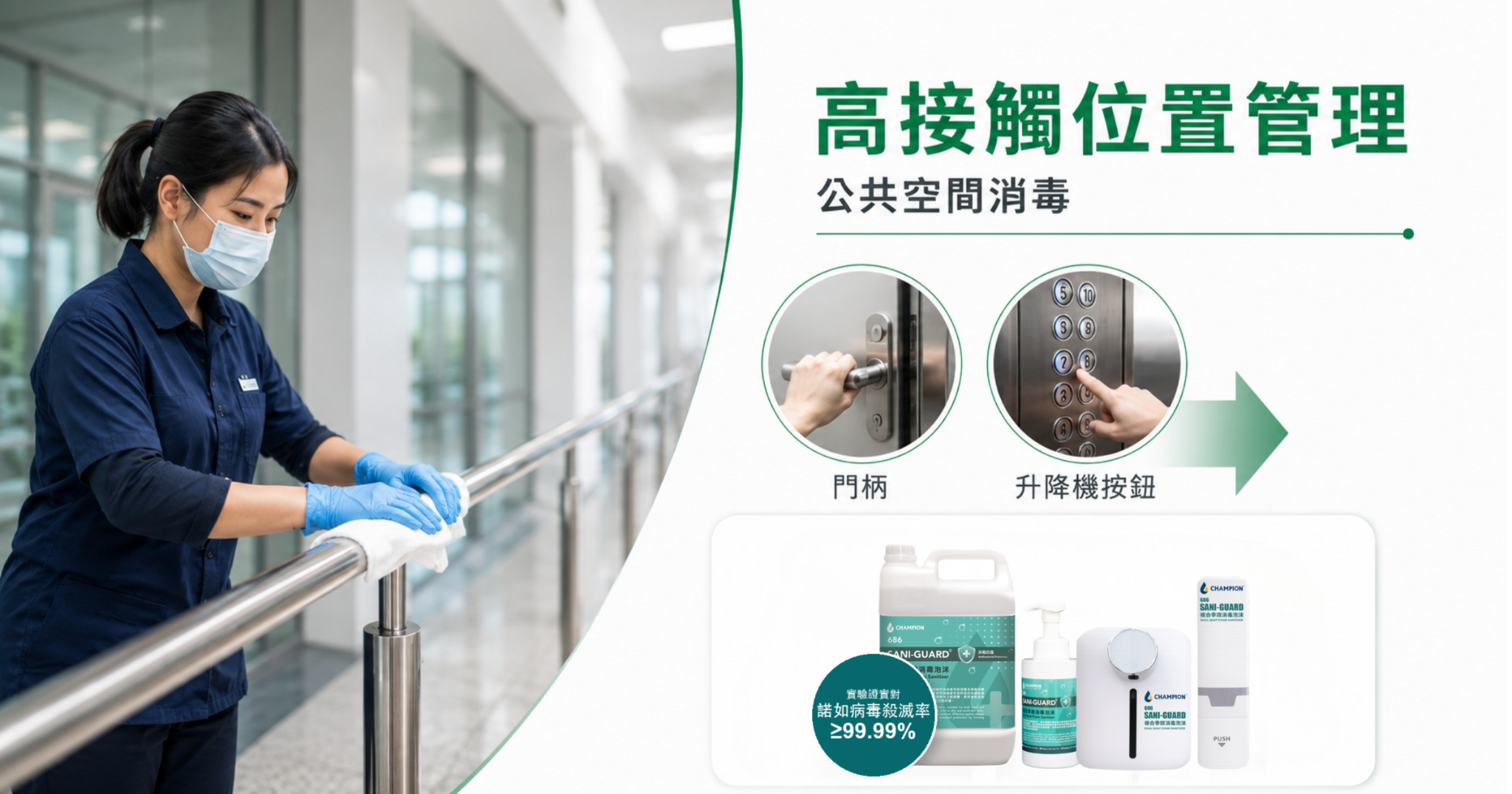
Public spaces come into contact with a large number of users every day, and areas such as door handles, handrails, elevator buttons, public facilities, and service counters are all high-frequency contact areas.
Simple cleaning can remove surface stains, but for high-occupancy areas, property management teams also need to consider a more complete disinfection process to reduce hygiene risks.
Shopping malls, hotels, office buildings, schools, and medical institutions all need to establish appropriate disinfection management systems based on their usage to ensure that public areas maintain a stable level of hygiene.
Champion's commercial disinfection solutions can help various commercial venues establish more comprehensive hygiene management processes.
For related products, please refer to:686 SANI-GUARD® Dual-Quat Foam Sanitizer
How can restroom management shift from problem-solving to prevention?
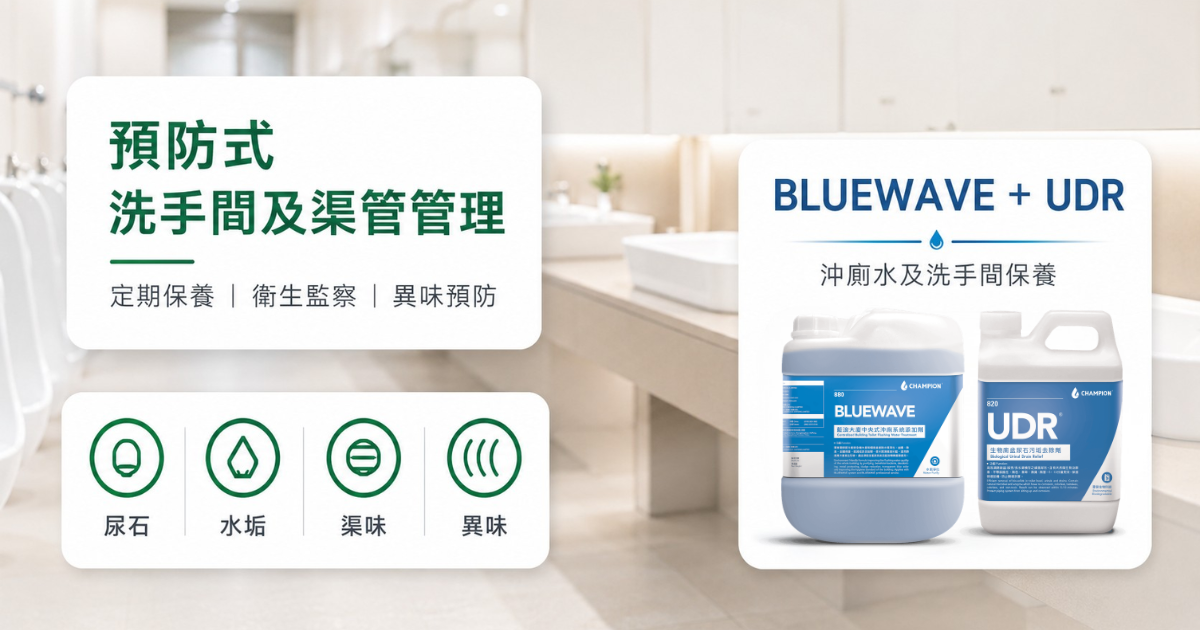
Restrooms are usually one of the areas that receive the most attention in property management.
Users' perception of the restroom environment depends not only on the cleanliness of the surface, but also on the smell, the condition of the equipment, and the overall level of hygiene management.
Traditional property management models might involve arranging deep cleaning or special treatments only after receiving complaints. However, for shopping malls, hotels, and large public facilities, a more effective approach is to establish regular inspection and preventative maintenance procedures.
For information on sources of bathroom odors and common solutions, please refer to:Why Bathroom Odours Keep Coming Back: 5 Common Sources and Solutions
For relevant property hygiene management plans, please refer to:Champion Property Management Hygiene Solution
Champion Property Hygiene Management Solution
Champion's property hygiene management solutions are not the application of a single product, but rather an integration of public space disinfection, restroom maintenance, source treatment, odor management, and air quality improvement, tailored to different environments, usage conditions, and hygiene requirements.
Odor management is a crucial aspect of this process. Before addressing any issues, it's essential to identify the sources of problems such as ductwork, organic matter buildup, bathroom deposits, or air quality issues, and then develop appropriate cleaning, maintenance, source control, and air management plans.
Truly effective odor management requires combining "air deodorization", "source deodorization", "surface cleaning" and "drainage treatment" to avoid merely masking the odor without addressing its root cause.
The management scope should cover drainage pipes, grease traps, garbage rooms, restrooms, public spaces, and air conditioning systems, fully covering the sources and transmission paths of odors in the property.
Combined with inspection reports, usage records, and odor complaint data, the property management team can track the effectiveness, continuously optimize maintenance frequency, and support ESG and management reporting.
| Source of the problem | Management direction | Related solutions |
|---|---|---|
| Drainage pipes and organic matter accumulation | Source treatment and reduction of odor generation | PRO-DIGEST |
| Bathroom deposits and maintenance issues | Regular maintenance and hygiene management | UDR, Toilet Care, BLUEWAVE |
| lingering odor | Air quality management | PureZone® |
Surface cleaning and disinfection
Champion's property management hygiene solutions offer a comprehensive approach, from source management and cleaning to air management, tailored to different needs and scenarios.
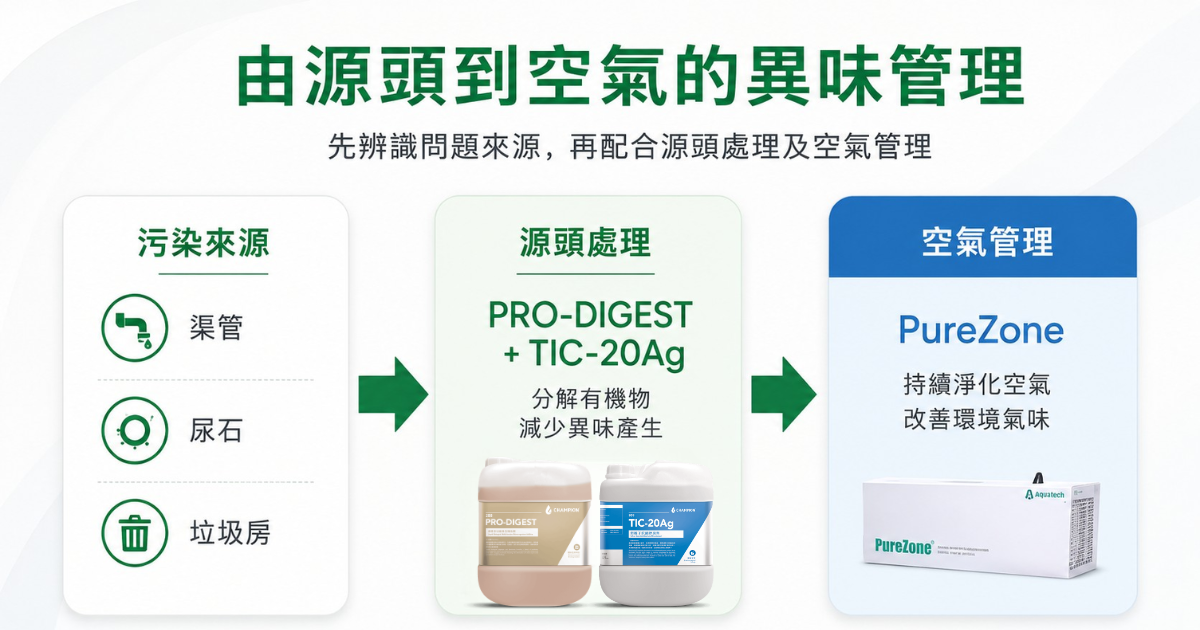
The relevant solutions can be referenced as follows:Champion Property Management Hygiene Solution
The overall scope of the plan is as follows:
| Management scope | Related solutions and directions |
|---|---|
| Public Space Hygiene | 686 SANI-GUARD® Dual-Quat Foam Sanitizer |
| Drainage and source management | 288 PRO-DIGEST and other source-treatment solutions |
| Toilet hygiene management | Maintenance plans such as UDR, BLUEWAVE, and Toilet Care |
| Air and Odor Management | PureZone®,TIC Air management solutions |
In addition to the above solutions, the following products can also be used in conjunction with different business environments, facility conditions, and cleaning needs:
- TIC-20Ag Silver Ion Antibacterial Deodoriser
- BLUEWAVE Centralised Building Toilet Flushing Water Treatment Additive
- 233 C33 Multi-Purpose Antimicrobial and Deodorant Cleaner
- 290 LIME-CLEAN-PLUS Liquid Mild Acidic Cleaner
- 207 CU-7 Multipurpose Stain Remover
- 226 SANICLEAN Antimicrobial Lotion Hand Soap
learn more:Champion Property Management Solution
Frequently Asked Questions
What areas does property hygiene management include?
Property hygiene management covers cleaning and disinfection of public spaces, washroom maintenance, odour control, drainage management and indoor air quality.
Why do property management companies need to establish standardized sanitation procedures?
Standardized processes help unify management standards, reduce the recurrence of problems, and improve overall management efficiency.
Is it enough to just use deodorizing products to solve odor problems?
Not necessarily. Effective odor management requires first identifying the source, and then combining source treatment, maintenance, and air management.
Can air management replace cleaning?
No. Air management is only one part of the overall sanitation process and needs to be combined with cleaning and source control.
Book a Property Hygiene Assessment
If you would like to learn about a suitable property hygiene management solution, please contact the Champion team to arrange a site assessment.