
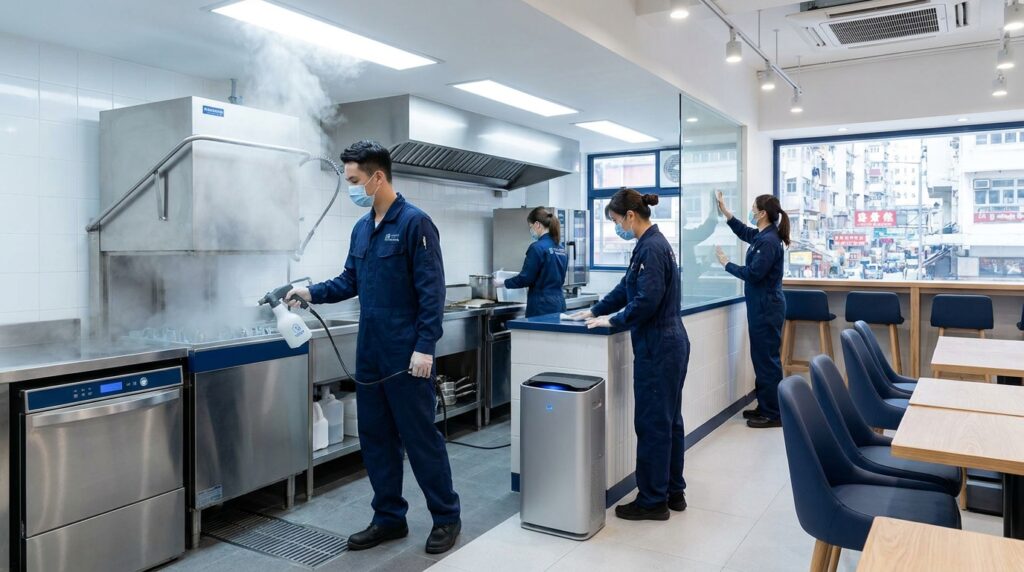
The operations manager of a chain restaurant held three meetings to discuss "what disinfection method should be used": the purchasing department wanted the cheapest chemicals, the kitchen manager wanted ultraviolet lamps, and the owner, based on a friend's recommendation, wanted to try ozone. Each side held their own opinion, money was spent, equipment was purchased, but hygiene problems persisted. Where did the problem lie? — They treated "disinfection method" as a tool...Multiple choice questionsBut actually it isMatching question.
For businesses operating restaurants, hotels, or properties, disinfection is a fundamental skill for hygiene compliance and brand trust. The market offers a wide variety of disinfection methods—ozone, ultraviolet light, chemical disinfectants, and bipolar ions—each with its own principles and applicable scenarios. Choosing the wrong method can result in poor effectiveness, or even harm to employee health or lead to complaints. This essential guide helps you understand these four main methods and teaches you how to combine them according to different scenarios.
📌 Key points of this article
- Disinfection is not a "single choice" issue, but rather..."Scenario-specific combinations"There is no single method that can simultaneously address air, surfaces, and tableware.
- Each of the four methods has its optimal scenario: ozone/UV (unmanned depth), chemical (surface), and bipolar ion (manned continuous air).
- A 75°C high-temperature dishwasher for tableware + surface chemical disinfection + bipolar air ionization is the most reliable business combination.
📖 Table of Contents
I. Comparison of Four Mainstream Commercial Disinfection Methods
| method | Principles/Advantages | limit | Most suitable scenarios |
|---|---|---|---|
| Ozone disinfection | Strong oxidizing, sterilizing, and deodorizing, with wide coverage | It is irritating; the area must be cleared and ventilated.Cannot be used when there are people around | Unmanned, enclosed, and thoroughly disinfected |
| UV-C | Destroys microbial DNA, leaving no chemical residue. | It can only irradiate a limited area, has blind spots, and direct sunlight can damage the skin and eyes. | Surfaces, unmanned spaces, inside air ducts |
| Chemical disinfection | Quaternary ammonium/alcohol, etc., provide instant sterilization and target surfaces. | It requires manual application, has residue considerations, and requires frequent application. | Countertops, kitchen and toilet surfaces |
| Bipolar ions | Actively decomposes germs and odorsSomeone is available,continued | Although it involves air treatment, the surface still requires chemical cleaning. | People, persistence, air and smell |
II. New Answer: Disinfection is not a "single-choice question," but rather a "combination of scenarios."
"Truly effective commercial sanitation isn't about asking 'which method is best,' but rather 'which location, which time of day, and which method to use.'"
Truly effective commercial sanitation doesn't ask "which planting method is best," but rather "..."Which location, which time period, and which method?A complete disinfection system should cover three levels:
- Tableware and kitchenware—A high-temperature dishwasher (75°C) is a sterilization standard that human hands can never achieve;
- Contact surface—Remotely treat countertops, door handles, and toilets with chemical disinfectants;
- air and smell—Use bipolar ions to maintain continuous ozone levels and avoid using ozone when people are present.
III. Practical Recommendations: Disinfection Combinations for Three Major Industries
Restaurants/Eaters
Kitchen and tableware surfaces are treated with a high-temperature dishwasher (75°C) and chemical disinfectant; dining areas are continuously treated with bipolar ions to remove cooking odors and air.Avoid using ozone during business hoursWith the plastic reduction policy, the demand for dishwashing has increased significantly, and a high-efficiency commercial dishwasher can solve the bottleneck of food preparation at the same time.
Hotel/Room
After check-out, ozone or UV light can be used for deep, enclosed disinfection; public areas and guest rooms are maintained with bipolar ions to keep the air fresh daily, and high-touch surfaces are treated with quaternary ammonium disinfectant foam. Air quality directly affects...First impressions upon check-inAnd evaluation.
Property/Commercial Building
Chemical disinfection and deodorization (such as for urinary stones) are used in restrooms and garbage rooms.Professional urinary stone removal agentBipolar ions are used in the lobby and elevator areas to improve first impressions; additionally, regular arrangements are made...Professional in-home deep disinfectionEstablish traceable health records.
- Did the tableware meet the requirements? 75°C High Temperature Sterilization(Hand washing doesn't achieve this)
- Does air disinfection affect business hours? (Some people use bipolar ion technology)
- Are high-frequency contact surfaces regularly chemically disinfected?
- Is there?Traceable recordsHow to deal with surprise inspections?
Champion provides all the equipment, chemicals, and on-site service for the above solutions, and can tailor a combination to your site and business model. Further reading:Does ozone disinfection have side effects? Essential reading before disinfecting commercial spaces..
Frequently Asked Questions
Q1: What kind of disinfection method should be used in commercial spaces?
There is no single answer. It should be based on a combination of "location + time period + object": use a high-temperature dishwasher for tableware, chemical disinfection for surfaces, and bipolar ionization for air disinfection. Only consider ozone or UV disinfection in a sealed, deep-dry environment.
Q2: Can ozone be used for disinfection during restaurant business hours?
Not recommended. Ozone is irritating and requires cleaning and ventilation. During business hours, methods that are accessible to people, such as bipolar ion therapy, should be used instead.
Q3: Which disinfection method is the most durable?
Bipolar ions can operate continuously for 24 hours, making them ideal for daily use; ozone, UV, and chemical disinfection are mostly "one-time" treatments, and their effects fade over time.
Q4: Is ultraviolet disinfection safe?
UV-C is effective in disinfecting surfaces and leaves no chemical residue, but direct exposure can damage the skin and eyes. It can only disinfect the area that is "exposed" to it, leaving some shadows and blind spots. It is also recommended to use it when no one is around.
Q5: Does a high-temperature dishwasher really clean better than hand washing?
Yes. Commercial dishwashers can sterilize at a high temperature of 75°C, a sterilization standard that cannot be achieved by hand washing. This can prevent cross-contamination of tableware and significantly improve food preparation efficiency.
Q6: Are there any residue issues with chemical disinfectants?
With proper dilution and rinsing, the risk of residue is manageable. Products that meet food contact standards should be selected and used as directed; specific formulas are available for different stains (such as oil stains and urine stones).
Q7: Does a restaurant need to use so many methods at the same time?
Not all of them are necessary, but it's recommended to cover at least three aspects: "high-temperature tableware + surface chemistry + bipolar air ionization". Champion can suggest the most streamlined and effective combination based on your scale and budget.
Champion provides a one-stop solution including equipment, chemicals, and on-site service.Free on-site assessment.
👉 Inquire via WhatsApp now