
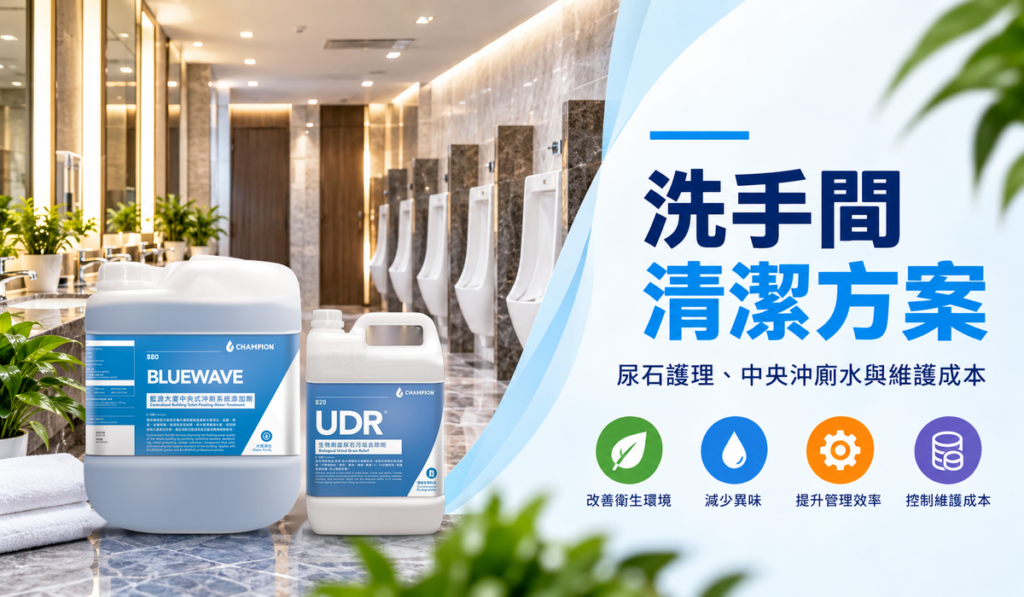
When managing washrooms in hotels, shopping centres, offices or residential estates, dealing with the dirt in front of you is only part of the job. You also need to know whether a problem will recur and how much staff time, scheduling and maintenance work each intervention requires.
Recurring urinal scale, ongoing care of a central flushing water system, toilet seat disinfection and handwashing supplies are separate tasks. Identifying the location and purpose of each task first helps you match products to a longer-term maintenance plan, instead of repeatedly increasing cleaning frequency or changing supplies.
CHAMPION supports hotels, shopping centres and property management teams across Hong Kong Island, Kowloon and the New Territories with professional cleaning products and central flushing water treatment. We can review your system, surface materials, footfall and cleaning procedures to recommend a suitable product and supply arrangement. See ourProperty Management Cleaning and Hygiene Solutions.
Explore our Hotel and Accommodation Solutions | WhatsApp Inquiry
Key Takeaways
- UDR supports both urinal scale treatment and scheduled care: look beyond the initial treatment and track any changes in scale recurrence and scale-related emergency work.
- BLUEWAVE works with central systems and automated dosing: dosing can be managed centrally, while essential equipment and hygiene inspections must continue.
- Value involves more than the unit price: record product, equipment, labour, emergency work and service interruptions separately, and keep material test conditions in view.
📖 Table of Contents
- Locate the Problem Before Choosing a Solution
- UDR: From Urgent Urinal Scale Treatment to Scheduled Care
- BLUEWAVE: Ongoing Care Starting at the Central Flushing Water System
- How Should Maintenance Costs and Staff Time Be Compared?
- What Else Is Needed for Toilets, Toilet Seats and Handwashing Areas?
- How Do You Move from Site Assessment to Supply Across Multiple Properties?
- Frequently Asked Questions
Locate the Problem Before Choosing a Solution
Slow drainage from a urinal may call for an inspection for scale or another blockage. Deposits on ceramic surfaces, high-touch points such as door handles, and the central flushing water system each call for a different approach.
When making an enquiry, share where the problem occurs, how often it happens, photographs, the products currently used and any maintenance records. Persistent leaks, backflow or suspected equipment damage should first be assessed by an engineer or other qualified specialist. A change of cleaning product cannot replace a necessary repair.
Odours may also originate from floor drains, ventilation or other areas. Read our guide tocommon sources of recurring washroom odours and how to address them, then discuss which parts of the process may benefit from a product solution.
UDR: From Urgent Urinal Scale Treatment to Scheduled Care
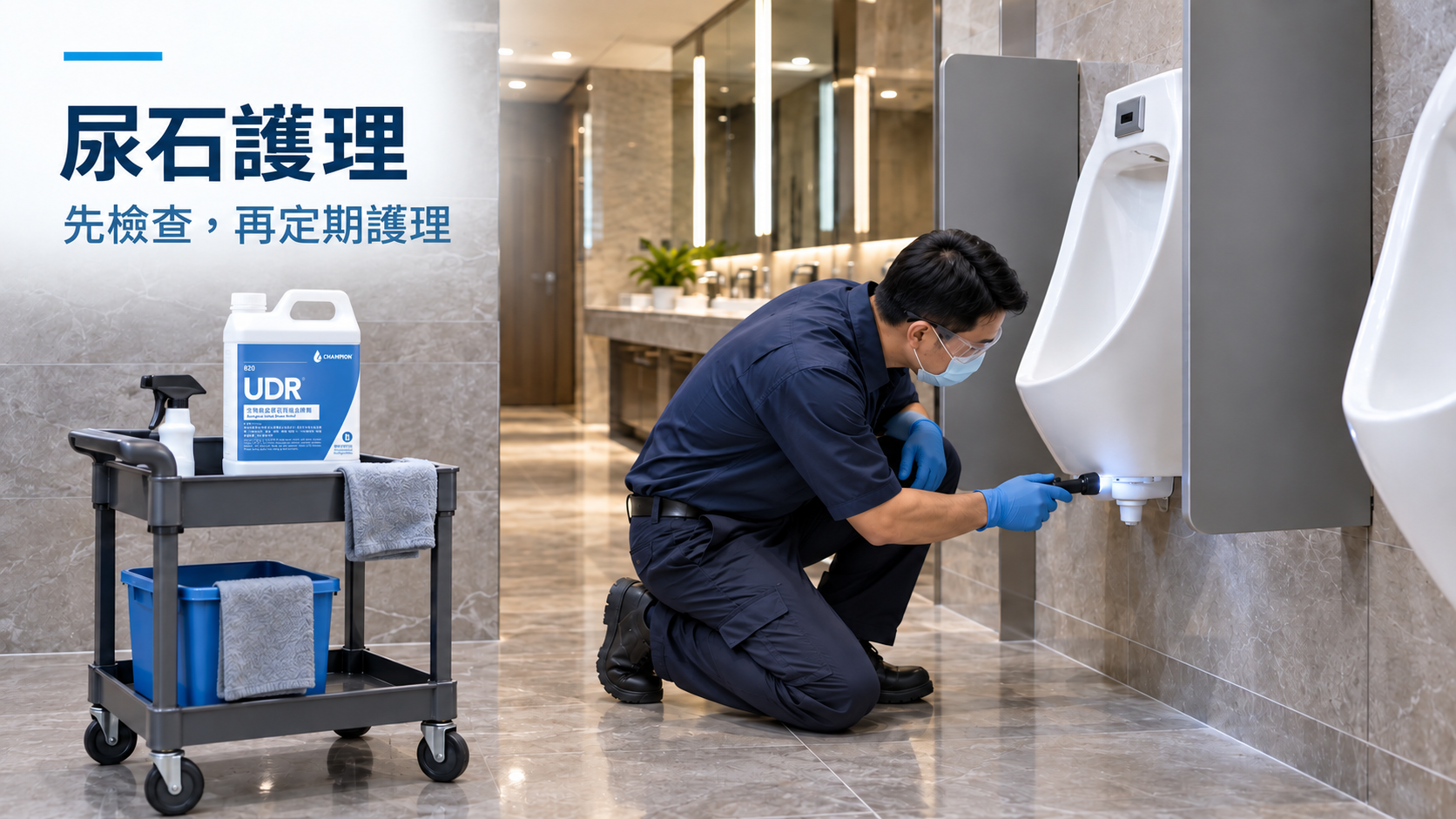
Address Organic Soil Within Urinal Scale Alongside Mineral Deposits
Urinal scale is more than a stain on the visible surface of a urinal. Over time, organic matter from urine and minerals in water can form a hard deposit on the drain outlet and inside pipework. Even after the visible surface has been scrubbed clean, deposits in less accessible drainage areas may remain and restrict flow.
820 UDR Biological Urinal Drain Relief combines a mild organic, phosphate-free acid with a mixed culture of live microorganisms to address organic soil and mineral deposits in urinal scale. The microorganisms can produce enzymes that penetrate compacted buildup and create a foaming action, gradually loosening its structure from within while dispersing and breaking down organic soil.
Once the deposit has loosened, rinse with clean water so the dispersed material can flow away. This approach reaches beyond the visible urinal surface to the outlet and inner pipe surfaces that are difficult to clean by scrubbing alone. It also provides a clearer basis for checking whether deposits remain.
Business Impact: Assess Whether Scale-Related Emergency Work Declines
Scheduled care aims to limit the return of urinal scale and reduce the need for unplanned drain clearing or temporary closure of part of a washroom. It also lets hotel and shopping centre teams, whose washrooms stay open for long hours, schedule work and staffing more easily.
UDR is also formulated with acid mist and metal fixtures in mind, including ingredients intended to inhibit metal corrosion. Combined with scheduled care, this may reduce the maintenance pressure associated with repeated scale treatment and help manage related repair costs. Actual results should be assessed against each site's maintenance and work records.
BLUEWAVE: Ongoing Care Starting at the Central Flushing Water System
Treat Flushing Water Centrally While Managing Sludge and Odour
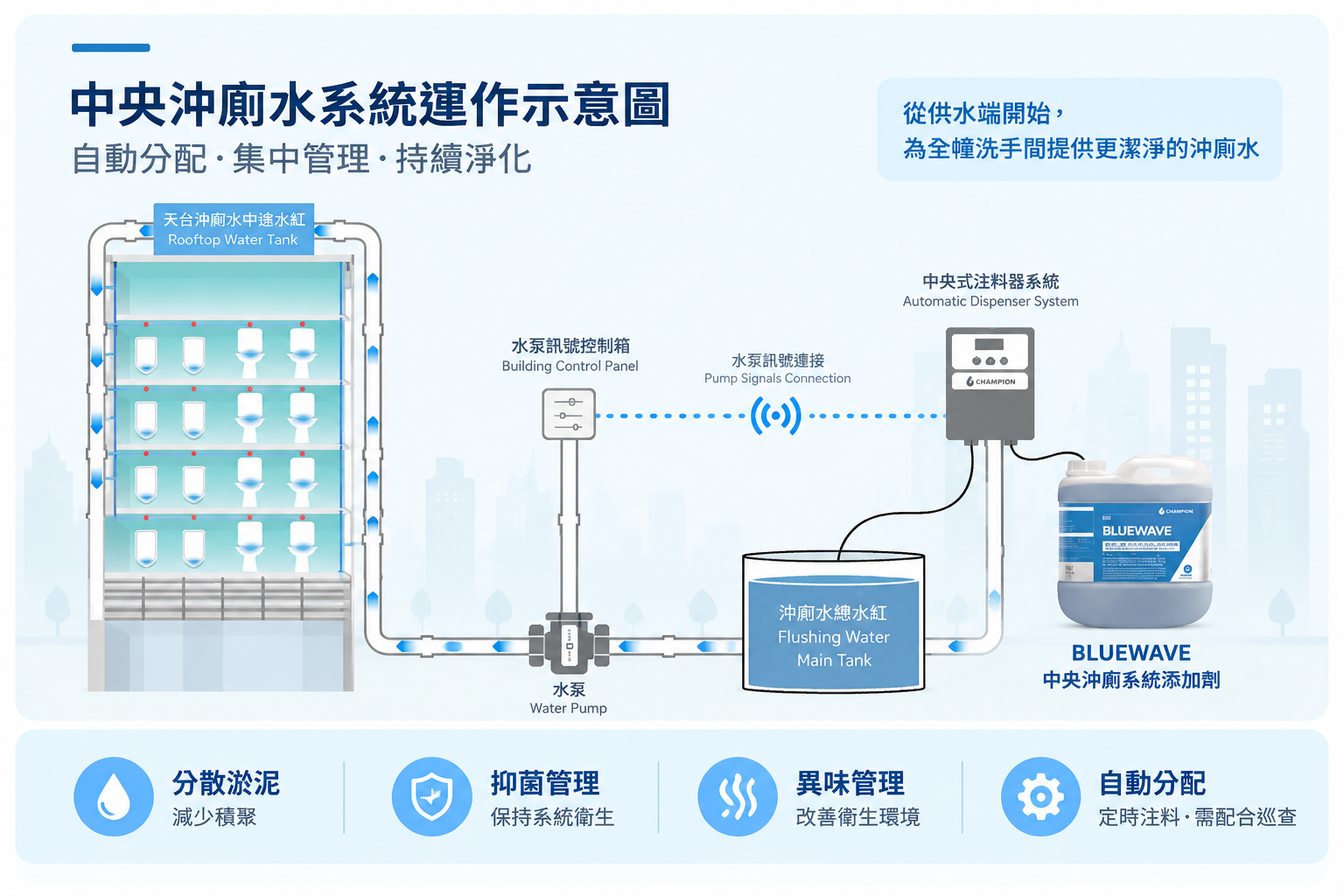
BLUEWAVE Centralised Building Toilet Flushing Water Treatment Additiveis designed for central flushing water systems. Its intended functions include dispersing sludge and helping to control bacterial growth and odour. Unlike treatment applied locally to an individual urinal, BLUEWAVE must be planned around the water supply system and dosing conditions.
For hotels and commercial buildings with central flushing water systems, it offers a way to organise treatment from the supply side. Suitability still depends on the water tanks, pipe network, supply zones and existing equipment.
BLUEWAVE: Features and Intended Functions
BLUEWAVE does more than add colour to flushing water. In a central system, it is intended to support sludge, water quality, odour and maintenance management. Its anionic surfactants help lower the water's surface tension and the adhesion between sludge and bacteria. This may help dispersed material flow away with the water and support drainage and odour management.
For water quality, the formulation is designed to help manage hard-water mineral ions, scale and suspended solids, while considering the protection of relevant metal fixtures in seawater-based systems. For a central flushing water system that operates for long periods, this allows routine water quality management and pipe and equipment upkeep to be considered together, before problems build up.
BLUEWAVE also contains organic antimicrobial ingredients intended to help control sludge growth and bacterial proliferation, addressing one possible source of washroom odour. These functions do not replace fixture surface cleaning or any necessary disinfection procedure. They complement day-to-day cleaning by giving the central system and frontline staff distinct roles. [2]
Automated Dosing: Manage Routine Additions Centrally
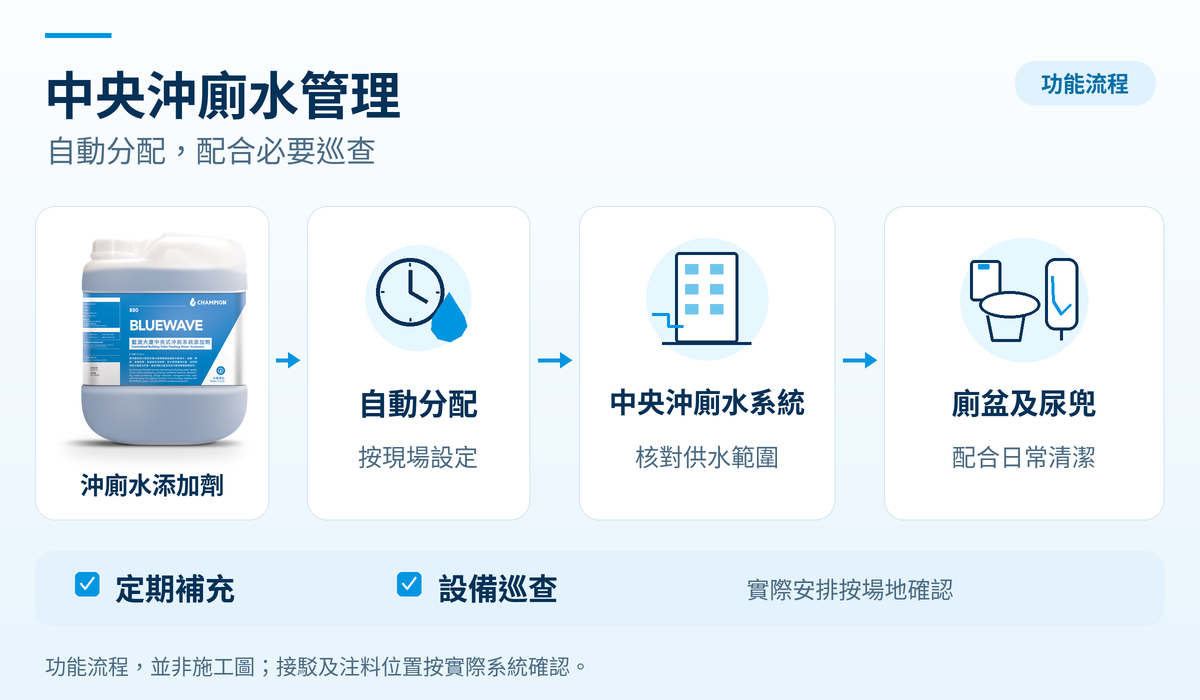
BLUEWAVE can be used with a fully automated programmable dispenser, with dosing times and quantities set to suit the system on site. Where dosing was previously done by hand, automation can bring the process under central control and help different shifts follow the same settings, reducing variation in operation.
Automated dosing still requires oversight. Equipment operation, chemical stock and on-site hygiene need regular checks. Equipment maintenance, parts and observed results should also be included in the ongoing plan, so the reduction in manual dosing does not come at the expense of essential system inspections.
Stainless Steel Testing: Another Check for Long-Term Maintenance
Central flushing water systems operate over long periods. Repairs to pipes or metal fittings can bring both engineering costs and disruption to washroom use. Product selection should therefore consider compatibility with fixture materials as well as water quality and odour management.
In a test using a 1:25 dilution and specified stainless steel coupons, the submitted 880 BLUEWAVE sample was rated essentially non-corrosive, with no significant visible change. This gives hotel and property management teams a defined test result to consider when planning stainless steel upkeep and potential repair costs. The finding applies only under the reported test conditions. [1]
For routine on-site dosing, an indicative dilution of approximately 1:10,000 to 1:15,000 may be considered. The actual setting must be adjusted to the site's water volume and system conditions.
Set Clear Roles for BLUEWAVE and UDR
BLUEWAVE supports the central flushing water system. UDR is applied to urinal scale at selected urinals, drain outlets and related pipe sections. Both products may serve different needs within one property, but a site does not necessarily need both.
First establish whether the property has a central flushing water system, where urinal scale is concentrated and how maintenance is currently handled. Then decide whether central system treatment, local urinal scale care or a combination is appropriate. If properties share a water tank or supply network, the engineering team should confirm the actual areas served before defining the assessment scope. A trial in one washroom cannot be assumed to leave all other areas unaffected.
How Should Maintenance Costs and Staff Time Be Compared?
Procurement teams should look beyond the price per litre. Compare the current approach and the proposed solution over the same period, for a similar workload, and with the same cost categories included.
UDR: Separate Initial Treatment from Routine Care Costs
The staffing, procedure and product quantity needed for an initial scale treatment may differ from those needed for scheduled upkeep. Recording the two separately helps management compare routine care with changes in scale-related emergency work: drain clearing, urgent contractor callouts, staff hours and partial closures. This gives a more reliable view of the value of scheduled care.
If a drain-clearing quotation already includes labour or parts, do not count them again in the total cost.
BLUEWAVE: Include Automated Dosing and Ongoing Maintenance
When evaluating BLUEWAVE, include the cost of the product, automated dosing equipment, installation, refills and ongoing maintenance. If the system reduces time spent on manual dosing and repeat treatment, the hours released can be reassigned to other cleaning work. This may improve how staff time is used without directly reducing payroll. The assessment should therefore cover time allocation, management efficiency and maintenance costs, including the regular inspections that remain necessary.
| Item to compare | Record for both the current approach and the new solution |
|---|---|
| Products and consumables | Initial treatment, routine upkeep, actual quantities used and purchase cost |
| Equipment and services | Installation, dosing equipment, maintenance and items already included in the plan |
| Related labour | Time for dosing, refilling, treatment, essential inspections and follow-up |
| Emergency work | Scale-related drain clearing, urgent contractors, overtime and confirmed repair costs |
| Operational impact | Partial closures, complaints, repeat treatment and other service effects; record these separately from direct costs |
Count any item already included in a quotation or monthly fee only once.
Difference in direct expenditure over the same period = direct expenditure under the current approach − direct expenditure under the new solution.
Staff hours available for reassignment = hours spent on relevant work under the current approach − hours spent on relevant work under the new solution.
If complete before-and-after records are unavailable, establish a baseline first; do not present expected benefits as savings already achieved. Note changes in footfall, events, contractors or other work carried out at the same time, so every difference is not attributed to the product.

What Else Is Needed for Toilets, Toilet Seats and Handwashing Areas?
Central flushing water treatment and urinal scale care do not replace cleaning fixture surfaces, disinfecting appropriate contact points or providing handwashing supplies. These tasks can be planned separately by use.
| Product | Primary use | Selection and use notes |
|---|---|---|
| 728 TOILET CARE Toilet Cleaner and Deodorizer | Descaling, cleaning and deodorising the inside of ceramic toilets and urinals | Clinging cleaner for fixture interiors; confirm material compatibility and protective measures first. It is not a general-purpose toilet seat product. |
| 686 SANI-GUARD Dual-Quat Foam Sanitizer | Disinfection of suitable high-touch hard surfaces | If it is proposed for a toilet seat, first confirm the seat material and specified directions, and follow the required contact time. |
| 226 SANICLEAN Antimicrobial Lotion Hand Soap | Handwashing at washroom sinks | Check dispenser or container compatibility, refill arrangements, footfall and consumption. |
Each product has a distinct role; every site does not need all of them. Manage cleaning, descaling, disinfection and handwashing according to the specified procedures. Do not mix products, increase their concentration without direction, or apply different products one after another to the same area without checking compatibility.
How Do You Move from Site Assessment to Supply Across Multiple Properties?
For an initial enquiry, provide the number of washrooms, problem locations, footfall, current products and maintenance records. A central flushing water proposal also requires the engineering team to check the system and the areas served by each supply zone.
Once the intended product uses are agreed, a limited-scope assessment can be arranged if needed. First define who will operate the system, how usage will be recorded, the review date and how exceptions will be handled. Assess local urinal scale care by fixture, but plan central system treatment by water supply coverage; the two cannot be divided into trial areas in the same way.
An assessment should examine performance after the initial work, under normal footfall, as well as the immediate result. Photographs and smell alone cannot establish disinfection efficacy. Nor can a short period without visible material damage replace product restrictions and technical information.
Before expanding across properties, standardise product names, intended uses, ordering units, training and refill contacts, and record any sites that need a different configuration. See our guide tostandardising hygiene management in property management.
Frequently Asked Questions
Will Regular Use of UDR Eliminate the Need for Drain Clearing?
That cannot be guaranteed. Scheduled care addresses the recurrence of urinal scale and related maintenance; other blockages, foreign objects or structural faults may still require professional attention. Use actual records to assess whether scale-related emergency work has declined.
Can Inspections Stop Once BLUEWAVE Is Dosed Automatically?
No. Automated dosing can take over the routine addition of product, but equipment, chemical stock and on-site hygiene still need inspection. Any change to staff schedules should be based on records and management requirements.
Can 686 Be Applied Directly to Every Toilet Seat?
Do not assume that 686 SANI-GUARD is suitable for every toilet seat. Before using it on a seat, confirm the material and the product’s specified directions, including any required contact time. Follow the latest product label and technical information.
How Are Site Assessments and Product Trials Arranged?
The published BLUEWAVE programme lists a free site assessment. Share your site details so we can confirm the appropriate assessment and demonstration arrangements. Longer trials, equipment and other support will be agreed as part of the proposed plan.
Book a Washroom Site Assessment and Consultation
Looking to improve urinal scale maintenance, manage central flushing water or update washroom supplies for a hotel or shopping centre? Tell CHAMPION where your site is, how many fixtures it has, what problems you face and how cleaning is currently organised. We can then discuss suitable products, supply arrangements and the scope of an assessment.
Enquire About Washroom Products and a Site AssessmentWhatsApp Inquiry
Safety and information note:
Always follow the latest product label, safety data sheet and technical information for the intended use, quantity, contact time, surface material and procedure. The metal test covered only the specified submitted sample and report conditions. Maintenance and staffing outcomes must be assessed from site records; they do not imply a fixed saving or remove the need for essential inspections.
References
[1] Guangdong Detection Center of Microbiology, report no. 2024FM19700R01, issued 25 November 2024. Submitted sample: 880 BLUEWAVE. Test: metal corrosivity (stainless steel). The result applies only to the submitted sample, specified stainless steel coupons and report conditions. It does not establish that all metals or on-site pipework will remain free of corrosion. The report's 1:25 ratio is a test dilution, not a recommended on-site dosing ratio.
[2] CHAMPION, M0053-MKT-NL-880 BLUEWAVE_Mobile product catalogue: central flushing water treatment, sludge dispersion, water quality and metal protection, antimicrobial action and related product functions.