
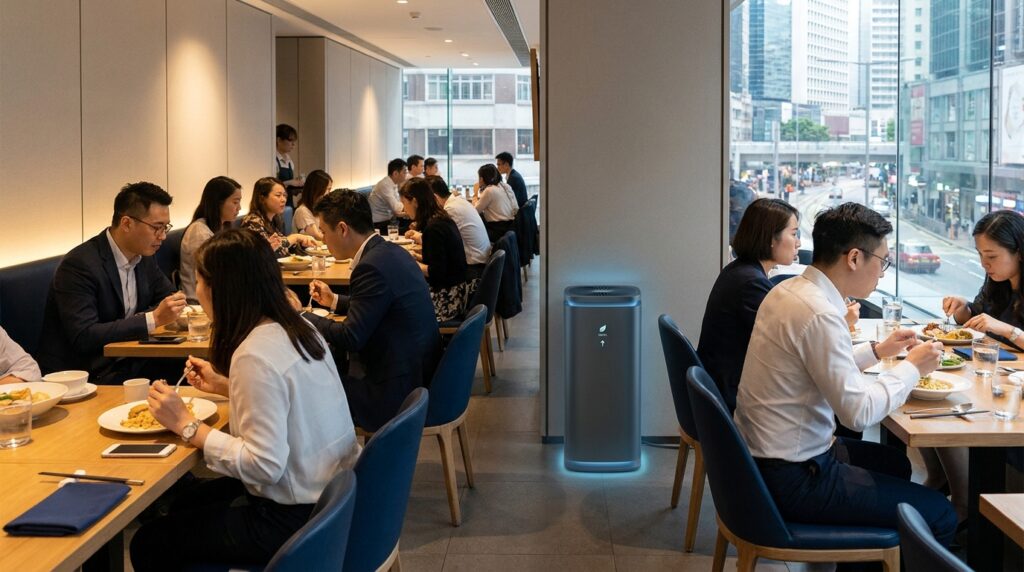
A Hong Kong restaurant owner spent several thousand dollars last year on an ozone sterilizer, which he heard could kill germs and remove odors. He turned it on every night after closing, and later even kept it running during business hours—but within a month, his kitchen staff began complaining of sore throats, headaches, and eye irritation. He was completely baffled: it was supposed to be "sterilizing," so why was it causing more harm than good?
If you are looking for a disinfection solution for a restaurant, hotel, clinic, or office,Ozone disinfection side effects"Ozone is a problem you must understand before making a decision." This article will help you break down the real risks of ozone in the simplest way, and provide safer alternatives in a "human, sustainable" business environment.
📌 Key points of this article
- Ozone has strong disinfection power, but it belongs to...Irritating gasIt is not suitable for continuous use in commercial environments with people.
- The smell of ozone often indicates a high concentration—clean air should...Tastelessof.
- Places with people and continuous activity should be repurposed.Bipolar ions (PureZone)Ozone is only suitable for deep disinfection in enclosed spaces when no one is around.
📖 Table of Contents
- I. What is ozone disinfection? Its principles and shortcomings.
- II. Three potential side effects of ozone disinfection (detailed explanation)
- 3. New ideas: Disinfection is not "the stronger, the better", but "the right scene"
- IV. A Safer Alternative: Bipolar Ion Technology (PureZone)
- Frequently Asked Questions
I. What is ozone disinfection? Its principles and shortcomings.
Ozone (O₃) is a strong oxidant. Ozone sterilizers release high concentrations of ozone gas to oxidize and decompose bacteria, viruses, and odor molecules in the air and on object surfaces. Its strong bactericidal power and wide coverage make it commonly used for "unmanned sterilization" in enclosed spaces.
Many businesses mistakenly believe that "strong ozone" means "ozone is safe and can be used freely." The truth is quite the opposite:Because ozone is strong enough, it is also irritating to the human body.Both the World Health Organization and the Hong Kong Environmental Protection Department have set safe limits for indoor ozone concentrations.
II. Three potential side effects of ozone disinfection (detailed explanation)
1. Irritates the respiratory tract, eyes, and mucous membranes.
High concentrations of ozone can irritate the throat, lungs, and eyes, potentially causing coughing, chest tightness, headaches, and a dry throat. The risk is even higher for people with asthma, nasal allergies, or weakened respiratory systems. The discomfort experienced by the restaurant owner's colleague at the beginning of the article is a typical symptom of ozone overdose. In kitchens or dining areas where employees spend extended periods, this is a serious occupational health and safety issue that cannot be ignored.
2. Cannot be used continuously in an "occupied" environment.
Because ozone is irritating, ozone disinfection generally requires a "clearance" process: people must leave during disinfection, and the area must be ventilated for 30 minutes to 2 hours afterward to allow the concentration to drop to a safe level before people can re-enter. For restaurants, hotel lobbies, or clinic waiting areas with long operating hours and constant foot traffic, this means you...Unable to achieve continuous disinfection for 24 hours— And germs and odors don't just appear after you close the shop.
3. May accelerate the aging of equipment and decorations.
Ozone's strong oxidizing properties can accelerate the aging of rubber, certain plastics, and metal parts with prolonged exposure, causing hidden damage to precision equipment, electrical appliances, or interior decorations. In other words, the savings on disinfection costs may turn into future maintenance expenses.
3. New ideas: Disinfection is not "the stronger, the better", but "the right scene"
"Disinfection is not about "the stronger, the better", but "appropriate to the scene, sustainable, and safe for people." "
Many merchants believe that "the strongest disinfection method is the safest." However, professional hygiene management emphasizes...Use the right method and the right scenario.Ozone isn't bad, but it's only suitable for specific situations:
| context | Suitable methods | reason |
|---|---|---|
| Unmanned, enclosed, and thoroughly disinfected (e.g., guest rooms after check-out, kitchen after closing) |
Ozone/Ultraviolet rays | It can clear the area, has a wide coverage, and thoroughly disinfects. |
| Someone, continuously, for a long time (such as restaurants, lobbies, and clinics that are currently in operation) |
Bipolar ions (such as PureZone) | Available to people, leaves no harmful residue, and operates 24 hours a day. |
| High frequency contact surface (Countertop, doorknob, toilet) |
Chemical disinfectants | Instant surface sterilization |
👉 Further Reading: For a comprehensive comparison of four methods—ozone, ultraviolet light, chemical, and bipolar ion—please refer to our pillar guide. A comprehensive comparison of disinfection methods for commercial spaces.
IV. A Safer Alternative: Bipolar Ion Technology (PureZone)
If you need to disinfect and deodorize a "manned, continuous, and open" commercial environmentBipolar ionizationIt's a more suitable choice. Take Champion as an example. PureZone Bipolar Ion Air Purifier For example:
- Safe operation in manned environments—It does not produce harmful ozone residue and does not require site clearing and ventilation;
- Active decompositionOdors and germ molecules (address them at the source, rather than masking them with fragrances);
- 24-hour continuous operationTo maintain the freshness and hygiene of restaurants, hotels, clinics, and offices;
- Effectively addresses common odor problems in commercial spaces, such as cooking fumes, toilet smells, and musty odors.
In short: Ozone is suitable for deep disinfection in "unoccupied, short-term, and enclosed" environments; bipolar ions are suitable for daily air management in "occupied, continuous, and open" environments. Their uses differ, and choosing the wrong solution will not only reduce effectiveness but may also pose health risks.
- During disinfection, the siteWill anyone...(Some people → Avoid ozone)
- you need toOne-time deep disinfection, or continuous maintenance?? (Continuous → Bipolar ions)
- Will the plan be implemented?Produces harmful residues or irritating odors(Yes → This poses a risk to employees and customers)
Frequently Asked Questions
Q1: Does ozone disinfection have any side effects?
Yes. High concentrations of ozone can irritate the respiratory tract, eyes, and mucous membranes, potentially causing coughing and headaches. In commercial spaces where ozone is present, strict control of concentration and ventilation time is necessary; otherwise, it may affect the health of employees and customers.
Q2: Are there any commercial disinfection methods that are safer than ozone?
Yes. Bipolar ion technology (such as PureZone) can operate continuously in occupied environments, actively decomposing odors and germs without producing harmful residues, making it suitable for 24-hour use in restaurants, hotels, and clinics.
Q3: How long after ozone disinfection can people enter?
Depending on the concentration, it is generally recommended to ventilate for 30 minutes to 2 hours after disinfection, allowing people to enter only after the ozone concentration has dropped to a safe level. Therefore, ozone is not suitable for continuous use during business hours.
Q4: Does smelling ozone mean the disinfection is effective?
Not necessarily. The presence of ozone often indicates a high concentration, potentially exceeding safe limits. Truly clean air should be odorless; judging disinfection effectiveness by "smell" is unreliable.
Q5: Can ozone generators be used in restaurants during business hours?
Not recommended. Using ozone during business hours poses health risks as staff and customers are present. During business hours, continuous purification solutions such as bipolar ion therapy, which are "available to people," should be used instead. Ozone for deep disinfection should only be considered after closing time.
Q6: Will ozone damage my equipment or decor?
Prolonged exposure to high concentrations of ozone may accelerate the aging of rubber, plastic, and metal parts, causing hidden damage to electrical appliances and interior decorations. Intermittent use at low concentrations poses a lower risk, but caution is still advised.
Q7: Can bipolar ions completely replace chemical disinfection?
It cannot completely replace it. Bipolar ions primarily treat air and odor; frequently touched surfaces (countertops, doorknobs, toilets) still require chemical disinfection. The best practice is to use them in combination according to the specific scenario.
Q8: Which type of commercial space is best suited for bipolar ion therapy?
Restaurants, hotels, clinics, offices, schools, and other spaces where people spend a lot of time are the best places to use bipolar ion technology for continuous air management; the effect is most obvious in places that emphasize first impressions and air quality.
Champion's PureZone bipolar ion air purifier can operate safely 24 hours a day in occupied environments. We offer...Free on-site air quality assessmentWe will provide customized solutions based on your venue.
👉 Inquire via WhatsApp now