
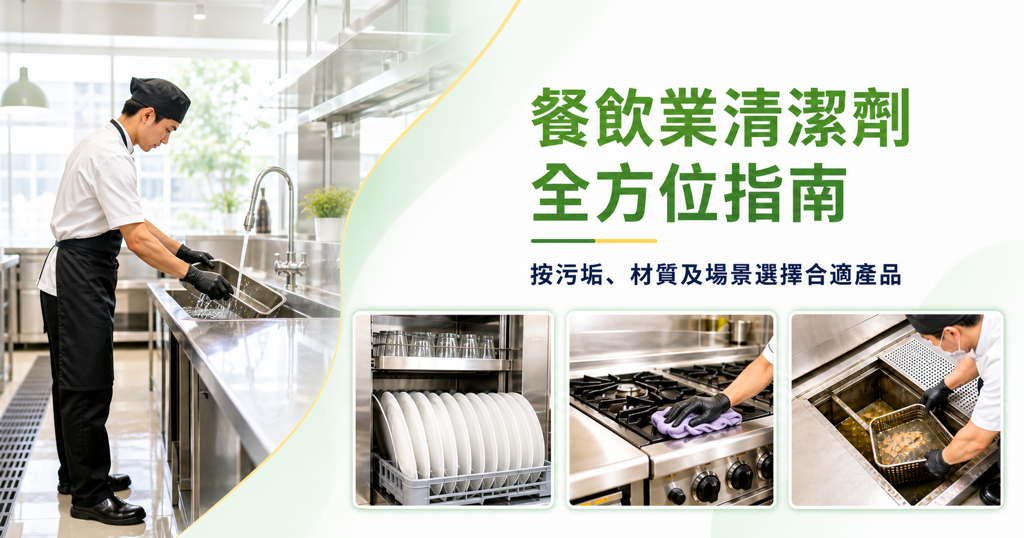
Restaurant cleaning agents are not necessarily better the stronger they are, nor can a single product handle all types of dirt. Restaurant kitchens contain grease, coke, protein, limescale, food scraps, and grease traps, and the materials, temperatures, cleaning methods, and food contact risks vary depending on the location.
Choosing the wrong product can lead to repeated cleaning by employees, increased water and chemical usage, and even damage to stainless steel, aluminum, natural stone, flooring, or equipment surfaces. On the other hand, even if the product is chosen correctly, inconsistent dilution ratios, contact times, and cleaning tools can make it difficult to maintain the desired results.
Therefore, a complete cleaning solution for the food service industry should start from the "source of dirt", then match the products, concentrations, tools, frequency and responsible persons, and transform personal experience into an executable standard process through record-keeping and training.
Key Overview
Dishwasher cleaners and quick-drying agents have different functions and need to be used in conjunction with the equipment and water quality; stove degreasers must be selected according to the degree of grease, surface material and operating temperature.
Kitchen floors must be treated simultaneously for heavy oil, protein stains, water accumulation, and slippery risks; grease traps and drains should be maintained continuously, not only after blockages occur. Products in food contact areas must have clear instructions on usage, dilution, contact, and rinsing, and products that meet HACCP food safety requirements and have obtained China Environmental Label certification should be selected as needed.
📖 Table of Contents
- Why can't there be one universal cleaning agent for the restaurant industry?
- What should you consider before choosing a commercial cleaning agent?
- What products should be paired with different kitchen settings?
- How to establish a standardized cleaning process?
- How to schedule daily, weekly, and deep cleaning?
- How to manage cleaning agent usage, inventory, and costs?
- What do food safety and environmental certification documents represent?
- What are some common mistakes restaurants make when using cleaning agents?
- How to train employees and check their effectiveness?
- Frequently Asked Questions (FAQ)
Why can't there be one universal cleaning agent for the restaurant industry?
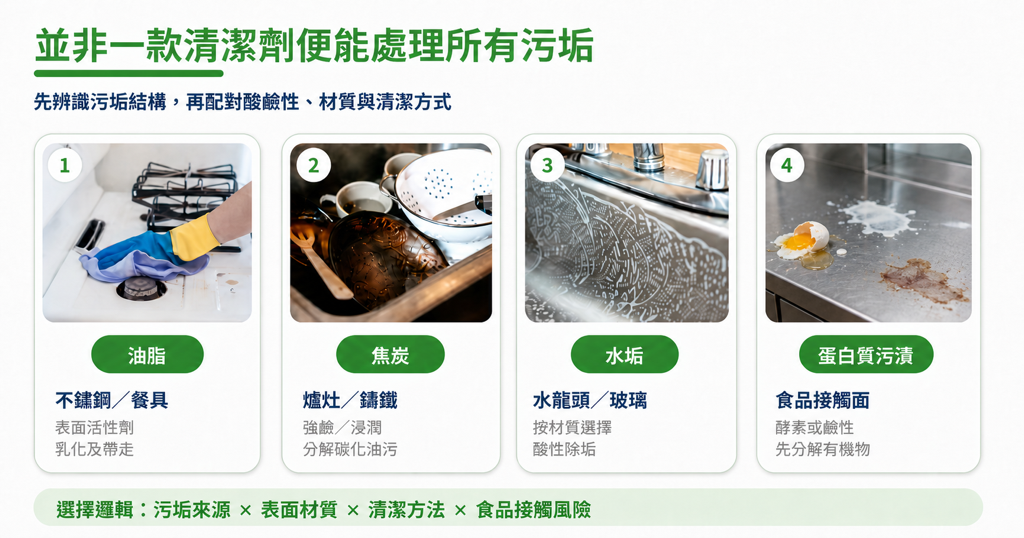
Fresh grease on tableware, hot coke on the stove, protein stains on the floor, limescale near faucets, and hardened grease in drain pipes all have different structures and causes. Effective cleaning requires the use of appropriate acids or alkalis, surfactants, oxidation, or biological processes, rather than simply increasing the amount of cleaning agents used.
If the product's cleaning power is insufficient, employees may need to scrub repeatedly, increasing working hours and water usage; however, using products that are too strong or unsuitable for the material may cause the surface to lose its luster, discolor, or corrode. In particular, aluminum, zinc, tin, natural stone, and some coated surfaces have different tolerances to acid and alkali products, which must be confirmed before use.
Cleaning ≠ Disinfection
Cleaning primarily removes grease, dirt, and organic matter; disinfection reduces the risk of microorganisms on cleaned surfaces by applying a specified concentration and contact time. If the surface still has thick layers of grease or food residue, directly using disinfectant products may not achieve the desired effect.
What should you consider before choosing a commercial cleaning agent?
First, identify the type of dirt.Grease, coke, protein, scale, rust, and organic deposits require different treatment methods. Managers can photograph and record the location, frequency, and formation time of the contaminants to make product selection more targeted.
Second, confirm the surface material.Stainless steel, cast iron, ceramics, glass, aluminum, natural stone, anti-slip tiles, and coated flooring have varying degrees of acid and alkali resistance. Product labels, technical data, or safety data sheets should specify the applicable and inapplicable areas.
Third, confirm the usage method.This includes machine washing, hand washing, soaking, spraying, foam cleaning, mopping, or automatic metered dispensing. The required concentration and contact time may vary depending on the method of application for the same product.
Fourth, identify food contact risks.Utensils, cutting boards, workbenches, cooking equipment, and products used in food processing areas must have clear instructions on dilution, rinsing, and contact times. Employees should not make their own judgments based on color or smell.
Fifth, consider the on-site water quality and temperature.Hard water can increase limescale and watermarks on dishes; surface temperature can affect the reaction speed and safety of degreasers. Before using high-temperature equipment, it is essential to confirm whether the product is suitable for hot surfaces.
Sixth, calculate the actual usage cost.While concentrated products may have a higher price per container, a higher dilution ratio, consistent usage, and fewer washes can actually result in lower cleaning costs per cycle. When purchasing, compare the cost per liter of working solution or per cleaning cycle, rather than just looking at the packaging price.
What products should be paired with different kitchen settings?
OTHER BRANDS
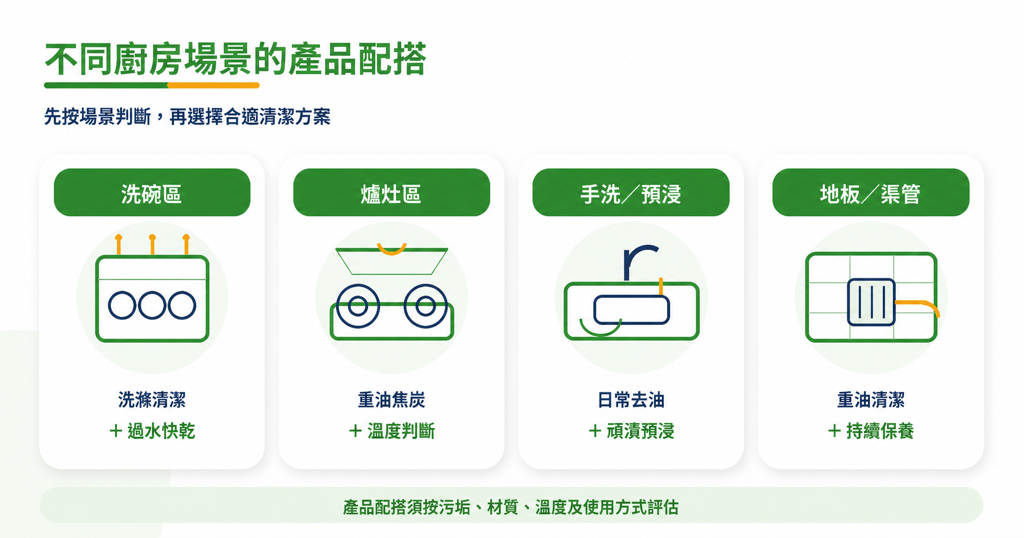
Machine washing systems typically require the use of detergents and quick-drying agents.360 DISH-PRO Super-Concentrated Dishwasher DetergentWith a highly concentrated strong alkaline formula, it saponifies grease and breaks down stubborn food residues during the washing stage, and is combined with water quality conditioning ingredients to inhibit limescale buildup.160 DRY-MASTER Super-Concentrated Dishwasher Rinse AidDuring the water rinsing stage, it reduces the surface tension of the water, speeds up drying, reduces watermarks, and uses a slightly acidic formula to slow down scale formation. The two have different functions and cannot replace each other.
The actual dosage needs to be adjusted according to the equipment model, water quality, dish soiling, and dispenser settings. If watermarks, foam, residue, or slow-drying dishes appear, do not immediately increase the dosage. Instead, first check the water temperature, spray arm, filter, detergent supply, and quick-drying agent settings.
Stove and oven
260 OVEN CLEAN Oven Cleaner and Heavy-Duty DegreaserSuitable for treating coke and heavy grease on alkali-resistant surfaces such as stainless steel and cast iron. Its low-odor and thickening design helps treat vertical surfaces of stoves and ovens.268 GREASE-MASTER Concentrated Oven Cleaner and Heavy-Duty DegreaserSuitable for thicker, more carbonized oil stains;278 COOL-DEGREASER High Concentration Powerful Stove Degreaser (for Low Temperatures)It is mainly used for surfaces at room temperature or below 60°C.
Safety Tips:
Before handling coke, shut down the equipment, remove loose residue, and check the surface temperature. Rinse thoroughly after use according to the instructions to avoid product residue. Do not assume "strong" is suitable for all materials; extra caution is needed on aluminum, zinc, tin, and other surfaces that are not alkali-resistant.
Hand washing and pre-soaking of tableware
208 SUNSHINE Heavy-Duty Manual Dishwashing DetergentFeaturing a powerful degreasing, low-odor, low-foaming, and easy-rinse formula, this product can be used on tableware, cookware, and greasy surfaces. Pre-soaking is also recommended as per product instructions. The low-foaming design helps shorten rinsing time, while pre-soaking softens dried stains, reducing the need for subsequent scrubbing.
If tea stains, coffee stains, lipstick marks, or dried oil stains cannot be removed by daily hand washing alone, please use the product as directed.222 POWER DIP PLUS Active Fast-Acting Pre-Soak PowderPre-soak the tableware in 50°C warm water. Its active oxygen and bio-enzyme formula targets pigments and oily stains, and is chlorine- and phosphorus-free. Suitable for ceramic, glass, stainless steel, and melamine tableware, but not for soft metals such as aluminum, zinc, and tin, or materials not alkali-resistant. After soaking, rinse thoroughly before proceeding with the normal washing process.
The handwashing area should separate the processes of scraping, pre-soaking, washing, rinsing and drying to avoid putting uncleaned tableware directly into the clean area.
Kitchen floor
238 FORCE Heavy-Duty Chlorinated Kitchen Floor CleanerSuitable for heavy oil stains in kitchens and food processing areas, as well as alkali-resistant floors such as tiles and cement. Floor cleaning is not just a matter of appearance; grease, food residue, and standing water increase the risk of slipping and can be carried to other areas by shoes.
When cleaning, first remove solid waste, then treat oil stains by area, scrubbing and rinsing. Finally, push the wastewater to the appropriate drain and allow the floor to dry. If the floor remains slippery for a long time, check the concentration of the detergent, tools, rinsing procedures, and drain openings, rather than simply increasing the amount of fragrance or cleaning frequency.
Further Reading:How to choose a floor cleaner? Safe cleaning methods for different materials.
Wall and equipment surfaces
661 FOAM CLEAN PLUS Chlorinated Foam CleanerIt can be used with specialized equipment to form foam, allowing the product to adhere to vertical surfaces for a longer period of time, helping to remove grease and protein stains. The foam allows operators to see the covered area, but it must still be used according to the specified contact time and rinsing procedure.
Before use, remove or cover food and packaging materials to avoid contaminating the treated area during cleaning. Different wall surfaces, adhesive edges, and equipment coatings have varying compatibility; for first-time use, test on an inconspicuous location.
Grease traps and pipes
288 PRO-DIGEST Liquid Multi-Purpose Microbial AdditiveIt can continuously break down grease and organic deposits, and works with an automatic dispenser to set the timing and amount of addition. The focus of this type of solution is continuous maintenance, reducing the risk of blockages and odors before grease completely solidifies and accumulates in large quantities.
Notice:
Biological pipe maintenance cannot completely replace grease trap cleaning, oil suction, or physical pipe unblocking. If the pipes are severely clogged, backflowing, or structurally damaged, professional inspection and cleaning are still required. The use of strong acids, strong alkalis, or high-temperature water may also affect the microbial program; mutual interference should be avoided on site.
Hand hygiene and high-touch areas
686 SANI-GUARD Dual-Quat Foam SanitizerCan be used on hands, countertops, door handles, handrails, and other high-contact hard surfaces as per product instructions. The foam pump head allows for precise dosage control, and the alcohol-free formula eliminates the risk of flammability.
Food service establishments should manage hand hygiene and surface hygiene separately, and provide clear instructions when washing hands, handling raw and cooked foods, touching garbage, and changing work areas. Any disinfectant product must be used according to the specified dosage and contact time; its effectiveness should not be judged by the strength of its odor.
How to establish a standardized cleaning process?
The first step in standardization is to create an area list, dividing the kitchen into areas such as receiving, storage, ingredient preparation, cooking, serving, dishwashing, garbage disposal, and drain cleaning. Each area should specify the main types of dirt, surface materials, products used, tools, dilution ratios, contact time, frequency, and responsible person.
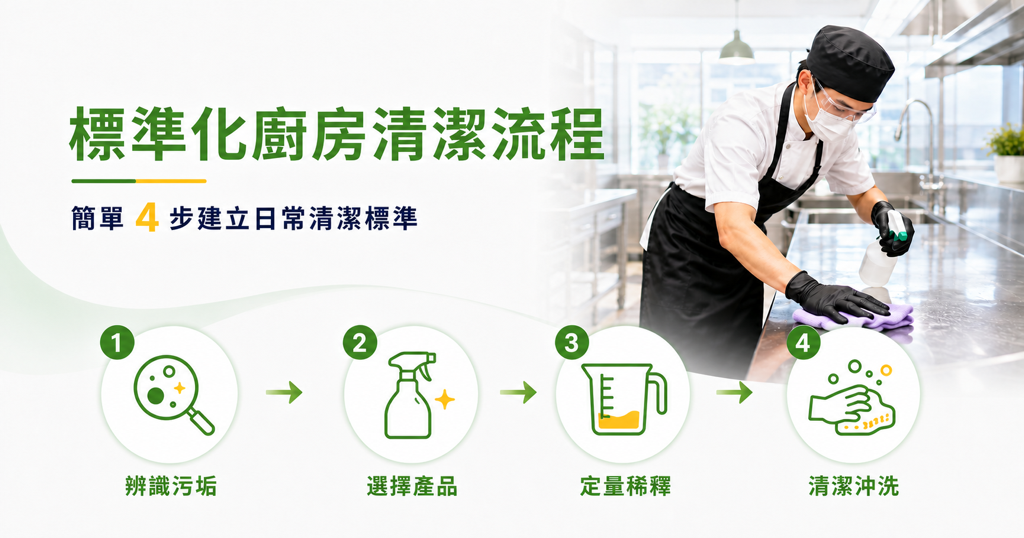
Catering businesses can establish the following procedures:
- Specify the products used and applicable scope for each location.
- Specify the dilution ratio, dosage per use, and contact time.
- Set up daily, weekly, and regular deep cleaning programs.
- Use different colored cleaning tools for different areas.
- Keep product labels and safety data sheets
- Train employees to identify acid and alkali products and incompatible materials
- Regularly check distributor settings, inventory, and actual usage.
- Record cleaning results, abnormal situations, and improvement actions.
Process documents should be placed in a location easily accessible to employees and should use the actual product names and pictures used on-site, avoiding vague terms such as "floor water" or "disinfectant." Before a new product is put into use, the processes, labels, and training materials should be updated accordingly.
How to schedule daily, weekly, and deep cleaning?
Daily cleaning should focus on food contact surfaces, tableware, worktables, floors, drains, and other high-touch areas to prevent dirt from lingering after business hours. Quick cleaning can be arranged between busy meal times, but it cannot replace the complete post-closing procedure.
Weekly cleaning can cover the appliance exterior, walls, refrigerator rubber edges, shelf bottoms, dishwasher arms, and less frequently moved corners. These areas may not be obvious on a daily basis, but long-term accumulation of grease and food debris increases the difficulty of cleaning and the risk of pests.
Regular deep cleaning should be performed on fume extractors, stove charcoal, grease traps, pipes, scale, and the bottom of large equipment, depending on the equipment and site conditions. The frequency should not be uniform but adjusted based on the rate of scale formation, complaints, inspection results, and maintenance records.
How to manage cleaning agent usage, inventory, and costs?
Uncontrolled cleaning agent costs are often caused not by rising unit prices, but by employees freely dispensing detergent, inconsistent dilution, dispenser errors, high rewash rates, or duplicate inventory. Automatic dispensers, measuring cups, metering pumps, and clear markings all help control dosage.
The management team can record the monthly inventory, usage, and remaining quantity of each product, as well as the number of tableware sieves and sales revenue, to observe whether the usage is in line with the workload. If the usage suddenly increases, leaks, equipment settings, employee operation, changes in dirt levels, and purchase records should be checked.
Businesses with multiple branches can standardize their core product list and coding to reduce the use of multiple products for the same purpose. Centralized procurement does not mean that all branches use the exact same concentration; it should still be set according to water quality, equipment, and scenario, but product roles and safety rules should remain consistent.
Storage requirements:
Storage areas should be kept well-ventilated, dry, and locked. Acidic, alkaline, or incompatible products should be stored separately, and original labels should be kept intact. Repackaged containers must also be clearly labeled with the product name, concentration, date, and intended use. Beverage bottles or unlabeled containers are strictly prohibited.
What do food safety and environmental certification documents represent?
Companies can prioritize products that comply with HACCP food safety requirements and, if necessary, obtain the China Environmental Label (Ten-Ring Certification). These certifications help procurement and management teams identify whether products meet relevant requirements, but do not mean that the products can be used on all materials, at all concentrations, or in all scenarios.
Certification cannot replace proper operation. Even if a product is suitable for food handling environments, employees must still adhere to labeling, safety data sheets, personal protective equipment, dilution, contact, and rinsing procedures. Technical information, training, and on-site assessments provided by the supplier should also be considered during the procurement process.
For businesses that need to handle internal audits, customer requirements, or chain management, it is recommended to keep product lists, certification documents, safety data sheets, training records, and periodic inspection checklists to ensure that hygiene processes are traceable, rather than relying solely on verbal instructions.
What are some common mistakes restaurants make when using cleaning agents?
Common mistakes include thinking that more product is better, mixing different products, ignoring material compatibility, not following the contact time guidelines, and not rinsing thoroughly after cleaning. Using too much product does not necessarily speed up cleaning; it may actually increase residue, foam, and water usage.
Another common problem is mistaking odor for cleanliness. Fragrance only alters the senses and does not indicate that grease, microorganisms, or drain deposits have been removed. If an odor persists, check garbage, grease traps, drains, floor drains, and ventilation sources.
Deep cleaning should only be scheduled when problems are obvious, as this increases costs. Effective sanitation management should combine daily cleaning, regular deep cleaning, equipment maintenance, and preventative measures in drains to control dirt buildup in its early stages.
How to train employees and check their effectiveness?
Training should not be limited to new employee onboarding. Updates should be scheduled whenever products, equipment, menus, work processes, or assigned areas change. Training content should include product usage, dilution, personal protective equipment, non-mixable items, accidental spill handling, and post-spill rinsing requirements.
Supervisors can verify that employees truly understand the process through on-site demonstrations and feedback, rather than simply signing off. During inspections, a short checklist can be used to observe whether there is still an oil film, watermarks, coke, or odor on the surface, and to check the product dosage, dispenser, and cleaning records.
Performance indicators may include dishwashing rewash rate, monthly detergent usage, slippery floor incidents, odor complaints, number of drain blockages, and deep cleaning hours. The purpose of these indicators is not to punish employees, but to identify areas where products, tools, frequency, or processes need adjustment.
Frequently Asked Questions (FAQ)
What's the difference between dishwasher cleaner and quick-drying detergent?
Cleaning agents primarily break down grease and food residue; quick-drying agents reduce the surface tension of water during the rinsing stage, accelerating the drying of dishes and reducing watermarks. Both should be used in conjunction with the equipment, water quality, and dispenser settings.
Does compliance with HACCP food safety requirements mean that the cleaning agent can be used on all surfaces?
No. Compliance with relevant food safety requirements does not mean the product is suitable for all materials, concentrations, or usage scenarios. Before use, you must still verify the product's intended use, material compatibility, dilution ratio, contact time, and rinsing procedure.
Can powerful degreasers be used on aluminum equipment?
Do not use without prior confirmation. Some strong alkali products are not suitable for aluminum, zinc, tin, and other materials that are not alkali-resistant. Please refer to the product and equipment instructions or confirm with the supplier before use.
Can I mix the two cleaning agents to enhance their effect?
Do not mix. Mixing different acids, bases, or chlorine-containing products may produce hazardous reactions, gases, or heat. Products must be used separately and handled according to the label and safety data sheet.
Can biological drainage pipe products replace drain cleaning?
It cannot completely replace biological treatment. Biological treatment is mainly used for the continuous decomposition of grease and organic deposits; severe blockages, backflows, or structural problems may still require physical cleaning and professional inspection.
How to reduce cleaning agent waste?
Overuse, leakage, and operational errors can be reduced through automatic dispensers, standard dilution ratios, quantitative tools, usage records, employee training, and regular inspections.
How do I determine if I need to replace the product?
If repeated washing is still required after a long period of time, even with the correct concentration, tools, contact time, and process, or if the product is incompatible with the material, water quality, or equipment, an on-site assessment should be arranged. Equipment malfunctions and operational issues should also be ruled out before replacing the product.
learn more:Cleaning and energy-saving solutions for the catering industry
Browse more:CHAMPION Product Center
Schedule a kitchen hygiene assessment
If it is uncertain whether the existing cleaning agents used in the catering industry are being used correctly, an on-site hygiene assessment can be arranged to identify high-dosage, high-risk, and recurring problems before developing appropriate product, dilution, tool, training, and management plans.
Safety Tips:
Before using any professional cleaning product, always read the product label and safety data sheet, wear the necessary personal protective equipment, do not mix different cleaning agents, and follow the specified dilution, contact, and rinsing procedures. This document provides general selection and management guidelines; actual use should be based on product information and on-site professional assessment.