
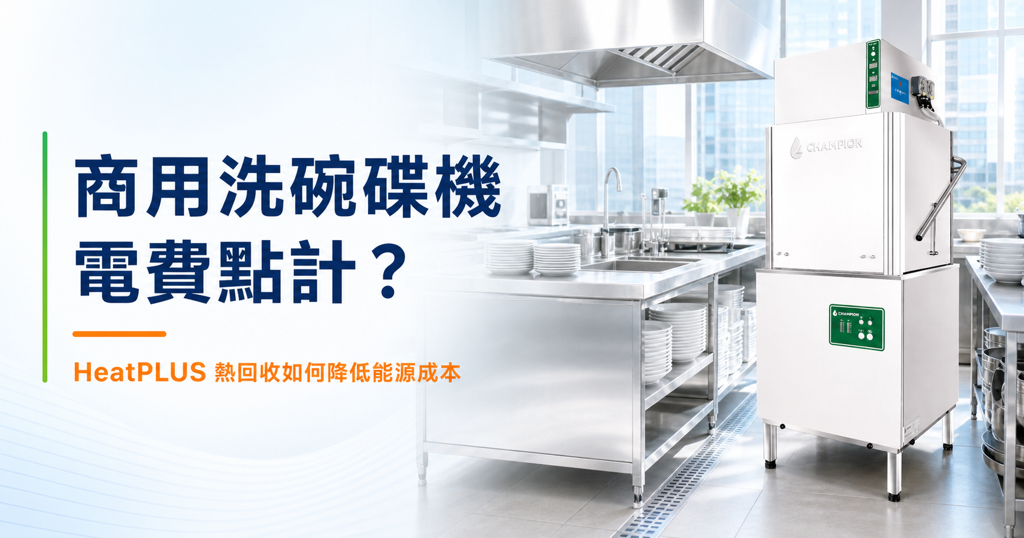
Electricity costs for commercial dishwashers are one of the most easily underestimated long-term expenses when catering businesses assess the operating costs of their dishwashers. The equipment needs to heat drinking water and maintain the washing and rinsing water temperatures every day. If it continues to operate during lunch, dinner, or even late-night hours, the energy deficit will accumulate over the months.
Many companies, when purchasing equipment, first compare machine prices, sizes, and hourly cleaning capacity, without simultaneously calculating electricity, water, cleaning agents, maintenance, and downtime labor costs. The result may be buying cheaper equipment but incurring higher overall operating costs later on.
Therefore, when choosing a commercial dishwasher, you should not only ask "how much does it cost?", but also understand "how much energy and water is needed to wash one sieve of dishes", "whether it can remain stable during busy periods" and "how much will the equipment cost over its entire lifespan".
Key Overview
The electricity cost of commercial dishwashers is mainly affected by hourly energy consumption, daily operating time, number of operating days, and energy prices. HeatPLUS recovers steam and waste heat during the wash cycle to preheat the incoming water, reducing the energy required for reheating.
Comparison of specified models and projects shows that annual electricity savings can be approximately HK$$27,125. When purchasing, the overall operating cost of the equipment should be compared, not just the initial purchase price; actual energy savings and payback period must be assessed based on site conditions, equipment condition, inlet water temperature, and usage patterns.
📖 Table of Contents
- What costs are included in the electricity bill for a commercial dishwasher?
- How do I calculate my monthly and annual energy costs?
- How does HeatPLUS heat recovery technology reduce energy consumption?
- Where does the energy-saving data for hinged-door dishwashers come from?
- How to compare the overall cost of using equipment?
- How to determine if HeatPLUS is suitable for a restaurant?
- Besides energy saving, what other benefits does heat recovery offer?
- What other operational advantages does the CHAMPION commercial dishwasher offer?
- What needs to be evaluated before selecting and installing a product?
- How can energy efficiency be maintained through operation and maintenance?
- What should a complete plan include?
- Frequently Asked Questions (FAQ)
What costs are included in the electricity bill for a commercial dishwasher?
The energy costs of commercial dishwashers come from more than just the main wash pump. The equipment also needs to replenish and heat the washing tub, maintain the washing temperature, perform high-temperature rinsing, and operate in conjunction with air extraction, ventilation, or hot water systems. Different models have different heating methods, insulation designs, water consumption per sieve, and standby control, so even with similar washing volumes, the actual electricity costs can vary significantly.
When calculating costs, the management team should at least separately record equipment operating hours, actual number of washing screens, electricity consumption, water consumption, and detergent usage. If only the total electricity cost of the entire restaurant is considered, air conditioning, refrigerators, cooking equipment, and lighting will be mixed together, making it difficult to determine whether there is room for energy saving in the dishwashing area.
In addition, the inlet water temperature also affects the heating load. The colder the inlet water, the more energy the equipment needs to raise the water to the specified temperature; conversely, if waste heat can be effectively recovered to preheat the inlet water, the heating requirement for each washing cycle can be reduced.
How do I calculate my monthly and annual energy costs?
The basic calculation method is:
Calculation formula:
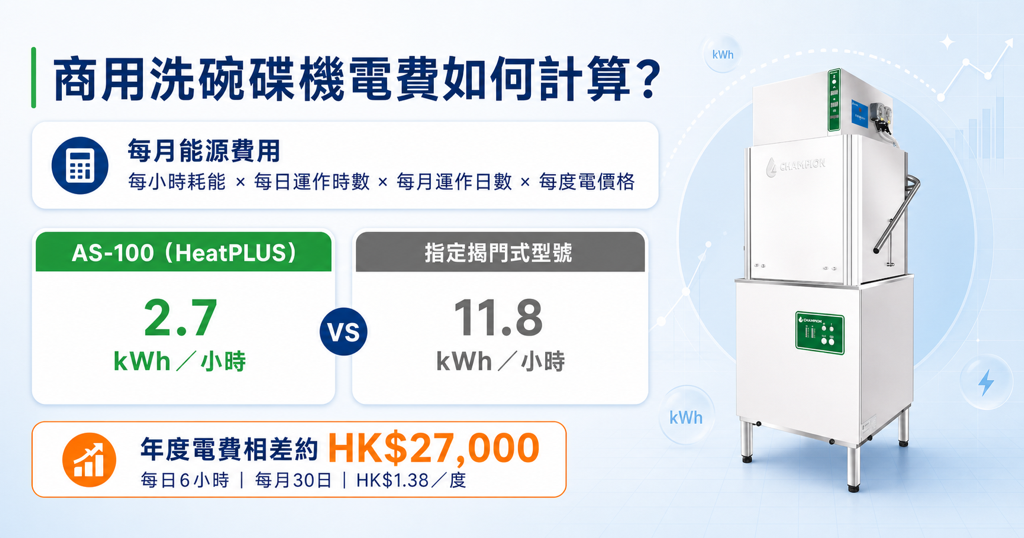
Monthly energy cost = Actual energy consumption per hour (kWh) × Daily operating hours × Monthly operating days × Price per kWh
Taking 6 hours of daily operation, 30 days per month, and HK$1.38 per kilowatt-hour as an example, the estimated results for the two door-mounted models are as follows:
| project | CHAMPION AS-100 (HeatPLUS) | Specified door-opening models available on the market |
|---|---|---|
| Energy consumption per hour | 2.7 kWh | 11.8 kWh |
| Daily Operations | 6 hours | 6 hours |
| Price per kilowatt-hour | HK$1.38 | HK$1.38 |
| Estimated annual electricity cost | Approximately HK$8,048 | Approximately HK$35,173 |
| Annual gap | Approximately HK$27,125 | — |
This formula is suitable for preliminary comparisons, but the total power on the equipment nameplate should not be directly taken as the actual daily energy consumption. Heaters, main wash pumps, and other components may not operate at full capacity simultaneously throughout the entire day; peak hours, standby time, water replenishment frequency, and washing modes will also affect the results. A more accurate method is to collect actual operating data under similar operating conditions and then make monthly and annual projections.
Businesses can first establish a baseline for at least one complete operating cycle, including weekdays, weekends, and peak hours, and then compare the energy, water, and cleaning agent consumption per 100 sieves of tableware. Using "cost per sieve" instead of just looking at the monthly total makes it easier to compare different branches, months, or equipment.
Further Reading:How to Reduce Commercial Dishwasher Operating Costs | Energy Efficiency, Maintenance and Management
How does HeatPLUS heat recovery technology reduce energy consumption?
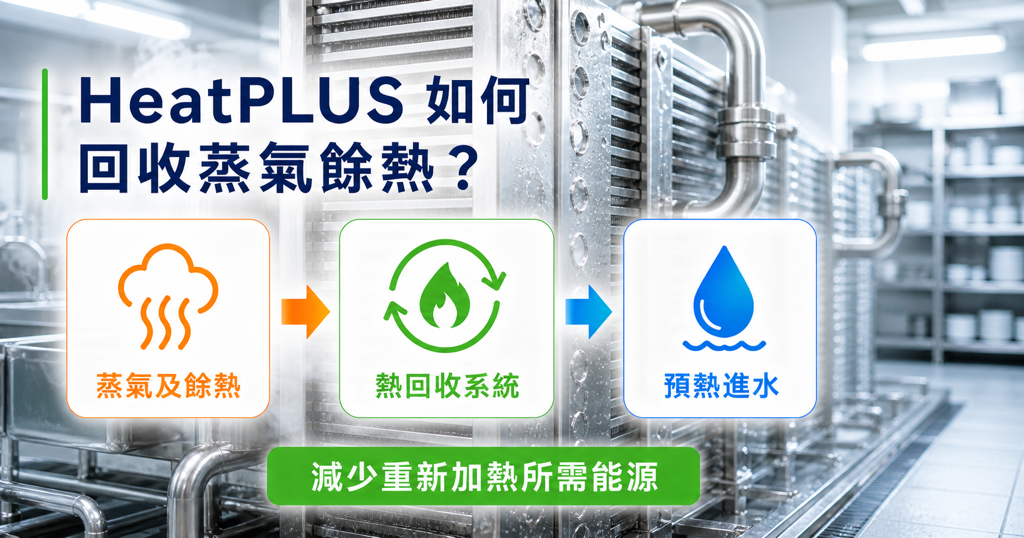
Traditional dishwashers often release steam and waste heat directly into the dishwashing area or remove it via an extraction system during operation. HeatPLUS's function is to recover this heat before it leaves the equipment and use it to preheat the water entering the system.
When the incoming water is preheated before entering the heating system, the equipment does not need to start heating from a lower temperature each time, reducing the energy required to raise the temperature to the designated washing and rinsing temperatures. Heat recovery does not lower hygiene requirements, but rather changes the source and use of heat energy, reducing energy waste while maintaining the cleaning process.
According to CHAMPION's product page, the AS-100 (HeatPLUS) utilizes second-generation patented heat recovery technology, achieving energy savings of up to 701 TP3T and water savings of up to 671 TP3T under specified comparative conditions, with a water consumption of 1 liter per sieve. The product also features double-layer insulation, multiple washing modes, and intelligent management functions, allowing energy saving, operational monitoring, and daily management to work together seamlessly.
Product Details:AS-100 (HeatPLUS) Smart Energy-Saving Door-Mounted Dishwasher (Heat Recovery)
Where does the energy-saving data for hinged-door dishwashers come from?
Hong Kong Green Building Council's "Guidelines for Energy-Saving Retrofitting of Buildings"The included project compares the AS-100 (HeatPLUS) smart energy-saving hinged-door dishwasher with other specified hinged-door models on the market through actual operational testing. Project results:
- Reduced electricity consumption by 16,656 kWh per year
- Annual electricity cost savings: HK$27,316
- Reduce carbon dioxide emissions by 6,496 kg per year
- Payback period of less than one year for specified direct purchase scenarios
Can larger models save even more?
HK$27,316 represents the empirical results of the aforementioned designated hinged-door dishwasher project. For conveyor belt, mini long-line, or long-line dishwashers with high throughput, the original energy baseline and daily operating load are usually higher; under suitable operating conditions, the absolute amount of energy and money saved annually by adopting energy-saving designs such as heat recovery, infrared sensing, or variable frequency conveying may be higher than that of hinged-door models.
byAS-F(MG) Smart Mini Long-Line Dishwasher (Heat Recovery)For example, the product is equipped with heat recovery and intelligent monitoring, and uses infrared sensors to adjust water and electricity consumption, adapting to higher processing volumes. This shows that even larger models can reduce resource consumption per unit of tableware through different energy-saving designs.
Important Reminder:
Larger models vary significantly in the number of cylinders, conveying speed, heating method, and cleaning capacity, and the HK$27,316 standard for gate-type projects cannot be directly applied. Each site should be calculated separately based on the existing equipment's energy consumption, daily operating hours, actual processing capacity, and energy prices.
When interpreting energy-saving data, it's crucial to pay attention to the benchmark. If the existing equipment is very old, uses a lot of water, or has deteriorated insulation, the savings after upgrading may be significant; conversely, if the existing equipment is already efficient, the savings may be smaller. The safest approach is to retain the original bills and operating records, and then establish a comparison under identical operating conditions.
How to compare the overall cost of using equipment?
Total operating cost refers to the total expenditure incurred by the equipment over its expected useful life, not the unit price. The assessment should include at least:
- Initial purchase and installation costs
- Annual electricity or gas cost
- Annual costs related to drinking water and sewage disposal
- Dosage of cleaning agent and quick-drying agent
- Regular maintenance, parts and repair costs
- Overtime costs, hand washing costs, or outsourcing costs during downtime
- Employee training and operational management costs
- Expected useful life and residual value
For example, two pieces of equipment may have different prices, but if the more efficient model reduces daily energy and water consumption, as well as cleaning agent waste and downtime risk, the price difference may be gradually recovered over the course of use. Therefore, management should compare costs over three, five, or the entire projected lifespan, rather than just comparing the quotes on the day of purchase.
Another important indicator is whether production capacity matches demand. If the equipment is too small, it will have to operate repeatedly and for extended periods during peak hours; if the equipment is too large, it may remain underutilized or frequently idle for extended periods. The appropriate equipment selection should be based on the hourly tableware volume, tableware types, peak meal times, and actual workflow.
How to determine if HeatPLUS is suitable for a restaurant?
HeatPLUS isn't just for restaurants with long operating hours or a particularly large volume of dishes. The assessment should focus on the energy and water performance of existing equipment, the dishwashing environment, dish handling processes, and the company's energy-saving goals. Whether it's a single-store restaurant, chain restaurant, hotel, banquet venue, residential compound, school canteen, staff restaurant, or central kitchen, anyone looking to improve energy use, steam and heat efficiency, or management efficiency can schedule an assessment first.
The following can be used as a reference for arranging energy assessments:
- The lunch and dinner services require the continuous processing of large quantities of tableware.
- Existing equipment has high electricity consumption or water consumption per screen.
- The dishwashing room has obvious problems with steam, temperature, and humidity.
- Quantifiable records of energy conservation and carbon reduction need to be established.
- With multiple branches, it's necessary to compare the performance of different equipment.
- We are short-staffed and hope to improve the turnover efficiency of tableware.
Site size should not be the sole criterion. Small restaurants can be assessed based on current energy costs, equipment aging, dishwashing environment, and improvement goals; medium to large sites can further compare the overall efficiency of different capacities and models. Ultimately, dimensions, door opening height, power supply, water supply and drainage, operational flow, and expected usage patterns should all be considered.
Besides energy saving, what other benefits does heat recovery offer?
First, recovering some of the high-temperature steam helps reduce the direct dissipation of heat into the dishwashing area, improving the temperature and humidity of the workspace. A more comfortable environment reduces the burden on employees working continuously in high-temperature areas.
Secondly, by reducing the water consumption per screen, the costs associated with drinking water, hot water, and drainage can be controlled simultaneously. Energy conservation and water conservation are not entirely separate issues, because the less water is heated, the less energy is usually required.
What other operational advantages does the CHAMPION commercial dishwasher offer?
First, the CHAMP-X™ smart dispenser can precisely supply detergent according to the settings, reducing the risk of over- or under-dispensing. Too little detergent may require the dishes to be washed again; too much detergent increases costs and rinsing burden.
Secondly, the intelligent management function can monitor the washing process, energy and detergent usage, and provide early warnings of anomalies. For chain restaurants, this data helps to standardize branch operations, identify abnormal consumption, and arrange preventative maintenance.
Third, consistent washing speed and output quality can shorten dishwashing time and reduce dish accumulation during peak hours. These operational benefits may not be directly reflected in the electricity bill, but they can impact staffing, table turnover efficiency, and coordination between the front and back of house.
What needs to be evaluated before selecting and installing a product?
On-site assessments should encompass equipment, space, energy, and workflows, rather than simply measuring aircraft dimensions. It is recommended to verify each item systematically.
- Maximum amount of tableware per hour and per day
- The proportions of plates, bowls, cups, dishes and tableware
- Disc loading, pre-processing, cleaning, disc ejection, and storage workflow
- On-site power supply capacity, incoming water temperature and water pressure
- Drainage location, platform height, and drainage capacity
- Equipment dimensions, door opening height, and maintenance space
- Ventilation, air conditioning, and temperature and humidity in the dishwashing room
- Storage and distribution locations of cleaning agents and quick-drying agents
- Number of employees, shift work and daily operating habits
- Future changes in seating capacity, meal times, or branch size
If these conditions are ignored, even if the equipment itself is highly efficient, it may fail to perform as expected due to poor flow, insufficient water supply, or inconsistent operating methods. After formal installation, trial runs, parameter settings, and staff training should be completed to ensure that on-site personnel know how to select washing modes, clean filters, and handle warnings.
How can energy efficiency be maintained through operation and maintenance?
Energy-saving equipment still requires proper operation. Large food scraps should be scraped off the tableware first, and the tableware should be arranged by category to avoid obstruction of the spray arms or the need for rewashing due to overcrowding. During peak hours, continuous operation should be maintained at a reasonable load per screen to minimize prolonged idle time or washing only a small number of tableware.
Clean the filter, wash arms, and tank residue daily, and check that the spray nozzles are clear. Weekly inspections should cover the door edges, rubber seals, limescale, and detergent supply. Regularly inspect the heating, temperature control, pump unit, distributor, and heat recovery components by a technician. Limescale, blockages, or incorrect settings can increase energy consumption and affect washing performance.
The management team can track energy costs, water consumption, detergent usage, rewash rate, number of malfunctions, and actual number of screens cleaned each month. If any indicator suddenly rises, the cause should be identified first—whether it's the equipment, detergent, water supply, or operational procedures—rather than simply instructing employees to reduce usage.
Related reading:Commercial Dishwasher Maintenance Manual: How to Avoid Costly Downtime?
What should a complete plan include?
Modern catering businesses need more than just a dishwasher; they need a management solution that can support their operations in the long term, including:
- High-efficiency, energy-saving equipment
- Intelligent heat recovery technology
- Precisely matched detergent programmes
- Rapid manufacturer-backed repair support
- Reliable local spare-parts supply
- Professional installation and commissioning support
- Comprehensive long-term preventive maintenance
- Structured operator and maintenance training
- Sustainable monitoring and cost review mechanism
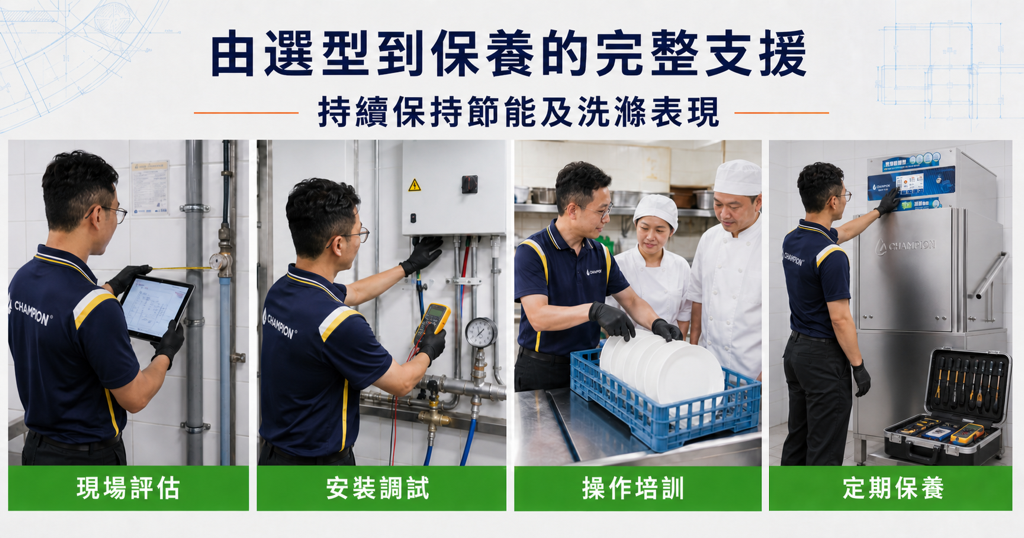
Champion helps food service businesses establish a more stable and cost-effective dishwasher operation model through equipment, service, and management support. Coordinating selection, installation, cleaning agents, maintenance, and training through a unified solution makes it easier to maintain consistent performance and reduces the gap in responsibility between different suppliers.
Related reading:How can ESG be implemented in the food service industry? How do gas-fired dishwashers support energy conservation and carbon reduction?
Frequently Asked Questions (FAQ)
How much electricity can the HeatPLUS commercial dishwasher save?
Comparison of designated products shows energy savings of up to 701 TP3T; designated projects included in the Hong Kong Green Building Council's data record annual savings of HK1 TP4T27,316. The two sets of data are based on different conditions, and actual results must be evaluated according to on-site equipment and usage patterns.
How can I tell if my current dishwasher is consuming too much electricity?
It can record equipment power, daily operating time, monthly energy costs, actual number of screens cleaned, and water consumption per screen, and then compare these data with equipment specifications and similar sites. If energy consumption continues to rise, scale buildup, heating, insulation, and operating settings should also be checked.
Do all restaurants have a payback period of less than one year?
No. Less than one year is the result of the specified project. The actual payback period depends on the energy consumption of existing equipment, the cost of new equipment and installation, daily usage time, energy prices, and maintenance conditions.
Does a lower total power consumption necessarily mean lower electricity costs?
Not necessarily. Total power is only one specification; actual operating time of the components, water replenishment, heating frequency, heat preservation effect, washing speed, and standby control must also be considered. Comparisons should be made based on actual energy consumption or test data under identical conditions.
Will heat recovery affect the washing temperature and hygiene?
The purpose of heat recovery is to preheat the incoming water and utilize waste heat, not to reduce the predetermined washing requirements. The equipment must still operate according to the specified procedures and temperatures, and be used with the correct cleaning agents, loading methods, and routine maintenance.
Is an on-site assessment required before replacing equipment?
Yes, it is necessary. On-site assessment can confirm the amount of tableware, space, power supply, water supply, drainage, ventilation and operating procedures, and can also identify installation limitations in advance, reducing the risk of modifying the project after the equipment arrives on site.
learn more:Cleaning and energy-saving solutions for the catering industry
Try calculating now:CHAMPION Energy Saving Calculator
Schedule an energy assessment and solution consultation
If you would like to know if HeatPLUS is suitable for your restaurant, hotel, residential community, school canteen, or central kitchen, please contact the Champion team to arrange an on-site inspection and energy assessment.
Note:
The product specifications and energy-saving percentages in this article are from CHAMPION's official product information; the project data are from designated cases listed in the relevant guidelines of the Hong Kong Green Building Council. Actual energy savings, water savings, and payback periods will vary depending on the equipment model, energy price, usage pattern, water supply conditions, installation, and maintenance.