
1. The Education Bureau subsidizes kindergarten ventilation testing costs of HK$15,000. If there is any remaining balance in the ventilation testing fees, can it be used to purchase air purification equipment?
A: No. According to the Education Bureau guidelines, kindergartens cannot combine the "Ventilation Inspection Service Subsidy" and the "Air Purifier Purchase Subsidy" (Figure 1). For example: if your school's ventilation inspection service quote is HK$14,000, the remaining HK$1,000 cannot be used to purchase air purification equipment.
Conversely, primary and secondary schools have more flexibility in applying for subsidies. According to the Education Bureau's guidelines, a one-off subsidy of up to HK$400,000 (Figure 2) can be used in conjunction with the "Ventilation Inspection Service Subsidy" and the "Air Purifier Purchase Subsidy".
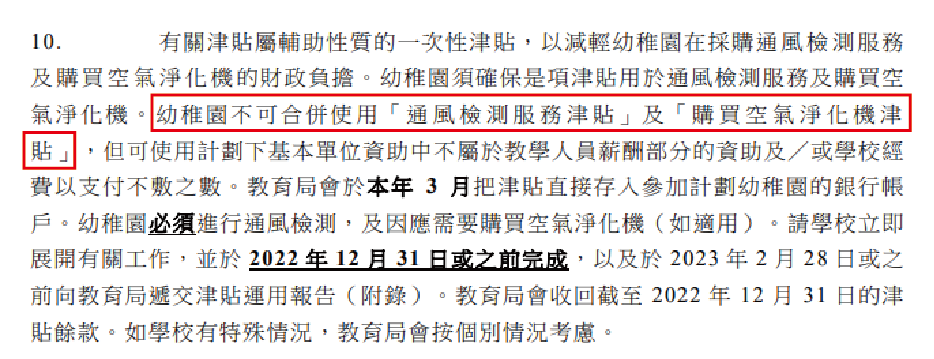
Figure 1: Kindergartens cannot combine the "Ventilation Inspection Service Subsidy" and the "Air Purifier Purchase Subsidy". (Source: Education Bureau)

Figure 2: There are no regulations requiring primary and secondary schools to allocate funds for "ventilation inspection service subsidies" and "air purifier purchase subsidies." (Source: Education Bureau)
2. If an air purifier is installed as recommended in the ventilation contractor's report, can we be assured of obtaining the relevant certification?
A: In principle, if the school fully improves the ventilation of the school building by following the measures recommended by the ventilation contractor, the ventilation contractor will conduct an on-site inspection and verification of the school building again as instructed by the Education Bureau.
If, upon verification, all measures have been properly followed up and implemented, the ventilation contractor will issue a certificate to the school confirming that the ventilation conditions meet the improvement recommendations in the report. Conversely, if the school fails to fully follow up and improve in accordance with the report's recommendations, it may not receive a certificate.
The following examples could lead to failure to obtain a certificate:
- The ventilation contractor required the school to install HEPA air purifiers, but the school installed UVC ultraviolet air purifiers or air purifiers that did not meet the Food and Environmental Hygiene Department's approval standards.
- Assuming a classroom area of 50 square meters, the ventilation contractor recommended that the school purchase a HEPA air purifier covering an area of at least 50 square meters. However, the school purchased a HEPA air purifier with a coverage area of only 40 square meters.
CHAMPION suggests that schools check with the contractor before purchasing air purifiers to see if the equipment meets the requirements of the recommended improvement measures.
3. How do ventilation contractors measure classroom air changes per hour and fresh air supply per student? And how can schools assist in completing the relevant testing reports more smoothly?
A: Generally speaking, ventilation contractors will prepare an anemometer and a measuring tape. The former is used to test the airflow rate in the classroom, while the latter is used to measure the area of the exhaust vents, the classroom area, and the height.
Schools, on the other hand, need to provide the ventilation contractor with the maximum number of people allowed in all classrooms in advance in order to more accurately measure the airflow in the classrooms.

4. The Environmental Protection Department's website covers many air quality indicators and guidelines, but the Education Bureau's guidelines have not yet been provided. Are schools required to comply and make improvements?
A: The indoor air quality index provided by the Environmental Protection Department is a two-tiered index for the Indoor Air Quality Assessment Scheme for Offices and Public Places, allowing the industry and the public to apply for "Excellent" or "Good" level certification for their premises.
The table below lists the indicators of indoor air quality (Figure 3). Two of them are areas where indoor air quality often exceeds standards or is overlooked: carbon dioxide and particulate matter. The former is used to assess an indoor space.Is the fresh air supply sufficient?The latter assesses an interior space.The risk of airborne transmission.
The Education Bureau is primarily targeting the hourly air exchange rate in school rooms and public areas, and the fresh air supply in liters per person per second. However, if schools are interested in improving overall indoor air quality, CHAMPION can also send personnel to conduct assessments of carbon dioxide and particulate matter.

(Figure 3) Indoor air quality indicators from the Environmental Protection Administration (Source: Environmental Protection Administration)
CHAMPION will collaborate with friendly ventilation contractors to provide services to schools throughout Hong Kong.School Clean Air ProgramPlan details:
- Arrange for a ventilation contractor approved by the Buildings Department to inspect the ventilation conditions of the school buildings.
- The ventilation contractor provides the school with a written inspection report, which includes the inspection findings and results, and specific recommendations, such as installing air purifiers with high-efficiency particulate air (HEPA) filters that meet relevant specifications, to help the school improve ventilation in its buildings.
- The ventilation contractor issued a certificate to the school confirming that the school building's ventilation conditions met the improvement recommendations in the report.
