

CHAMPION recently collaborated with the Hong Kong Economic Journal to provide the public with some basic knowledge on how to easily distinguish the cleanliness of tableware.
If you would like to review or refer to the content, please visit the following link.
Dirty tableware hidden in a can of cola reveals grime [Video available]
You might be wondering, "How can I wash cups without creating bubbles?"
This mainly falls into four common scenarios: (i) using pre-soaking; (ii) sorting tableware before washing; (iii) using a dishwasher; and (iv) post-washing techniques.
(a) Pre-soaking before washing
Pre-soaking can break down and soften stains beforehand, which can greatly improve the cleaning effect of the dishwasher.
To achieve a "foam-free" cleaning effect, pre-soaking is essential. Dishwasher and detergent alone are insufficient to remove stains from cups and may even leave residue, causing the aforementioned "foaming" phenomenon. The purpose of pre-soaking is to use a suitable pre-soaking agent to initially break down and soften the stains on the dishes, ensuring optimal cleaning results when using a dishwasher.
(ii) Properly classify the tableware to be washed.
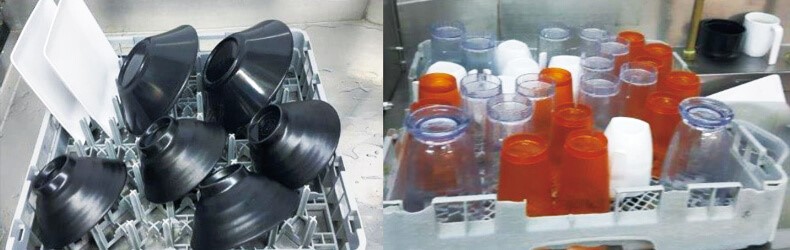 Sort tableware separately to avoid cross-contamination and improve cleaning effectiveness.
Before entering the dishwasher, tableware is often a major area of cross-contamination. Employees fail to sort the tableware, resulting in heavily greasy bowls being mixed with glasses containing only wine, and the oil easily remaining in the glasses.
(iii) The dishwasher should be equipped with a capacity sufficient to meet the restaurant's needs.
 You will need to use a washing kit suitable for your restaurant.
Many dishwasher suppliers rent and sell dishwasher equipment and cleaning agents, but few offer customized cleaning packages tailored to the specific needs of each restaurant. "Service" is something every restaurant must request from the supplier. Please remember, the fundamental purpose of using a dishwasher is to have clean tableware. The equipment and cleaning agents are merely "tools"; without proper washing design and user training, the dishwasher's full potential cannot be realized.
(iv) Hand gestures after cleaning must also be ensured to avoid secondary contamination.
Using your thumb to hold the edge of the bowl or plate while carrying it will prevent secondary contamination.
In fact, the way you place tableware also matters. It is recommended that dishwasher users use two separate pairs of gloves to handle both the dishes to be washed and those already washed, and when moving dishes, use your thumb to press down on the edge of the dish. This is because the most easily overlooked areas are often subject to secondary contamination after washing. The main reason is that once clean tableware comes into contact with dirty gloves and fingers, it instantly becomes contaminated, even though it is not visually noticeable.
The above-mentioned tips are essential knowledge for every food service worker. They not only ensure clean tableware but also enhance the restaurant's hygiene image. If you would like to learn more about tableware cleaning, or even have a professional hygiene consultant inspect and provide advice, please click [here].Contact UsLeave your information.