
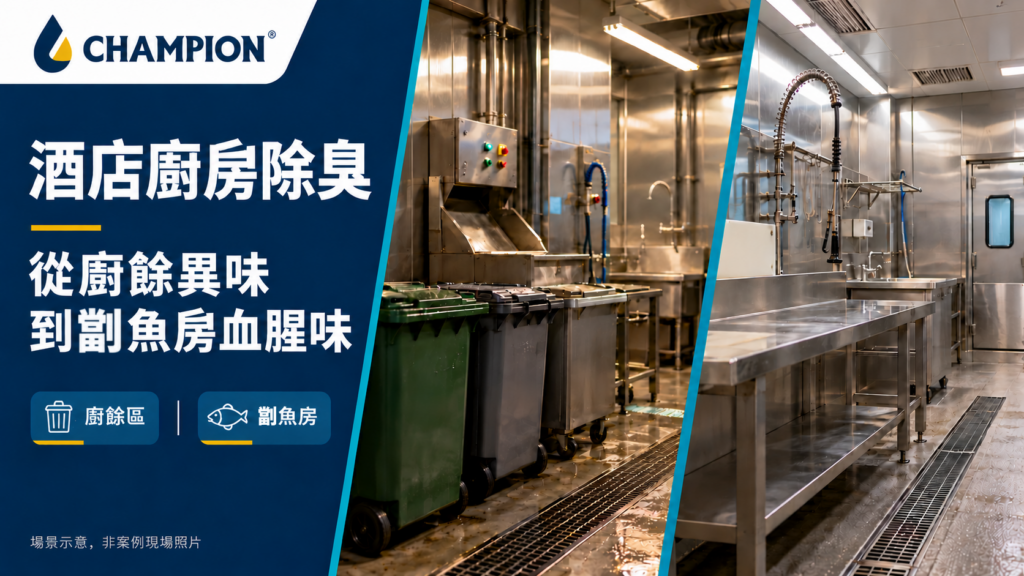
Food waste is removed daily and the floor is cleaned, yet odours persist in the hotel kitchen. Grease around food waste equipment, organic soil in drains, and blood and fish debris near preparation equipment may all need attention. Improving food waste odours and the smell of blood in fish preparation areas starts with matching the treatment to the actual problem.
Where food waste areas have both grease buildup and poor drainage, consider TIC-20Ag automatic spraying alongside a 288 PRO-DIGEST microbial additive system to address ambient odours and grease-related problems respectively. In fish preparation rooms, site conditions may call for TIC-20Ag together with 233 C33 to clean suitable surfaces. Drawing on CHAMPION and its practical experience, the following two hotel case studies explain where treatment is needed, how to select products and how to sustain odour control.
For coordinated cleaning and hygiene provision across different hotel work areas, explore the CHAMPION Hotel and accommodation cleaning solutions before assessing food waste areas, fish preparation rooms and other spaces individually.
Key Takeaways
- When food waste odours occur alongside grease buildup and poor drainage, plan ambient odour control and grease treatment together.
- For blood-related odours and surface soil in fish preparation rooms, combine TIC-20Ag ambient odour control with 233 C33 cleaning of suitable surfaces and the required food hygiene procedures.
- PureZone® uses bipolar ion technology to treat airborne odour molecules and gaseous odour sources. It can operate continuously alongside cleaning, waste removal and other odour-control measures.
📖 Table of Contents
- How should hotel kitchen odours be treated? Match the solution to the problem
- Food waste and fish preparation areas: how to identify odour sources
- Hotel case studies: treating odours in food waste and fish preparation areas
- Maintaining odour control: routine cleaning and follow-up
- Frequently Asked Questions
- Book a hotel kitchen odour-control consultation
1. How should hotel kitchen odours be treated? Match the solution to the problem
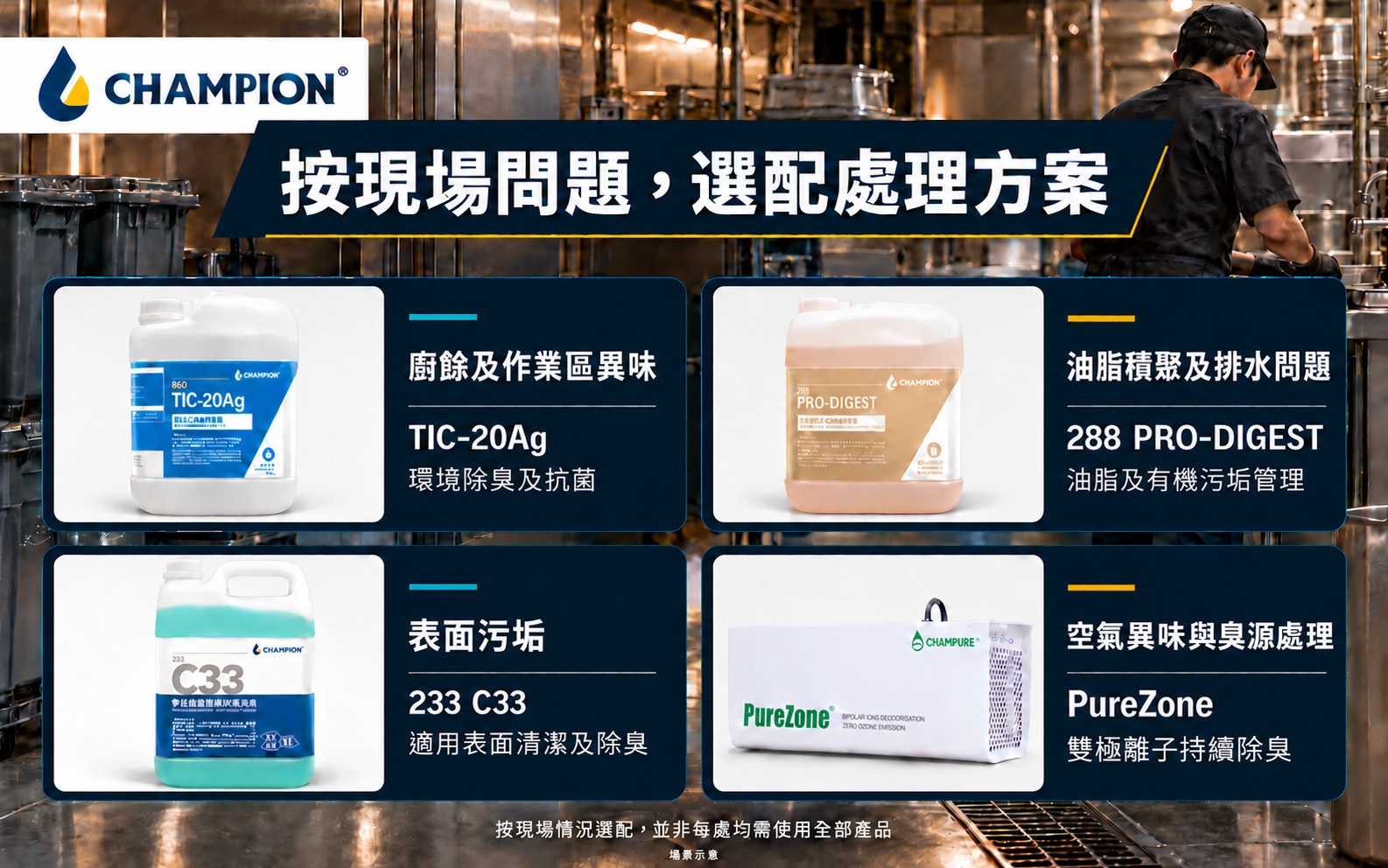
Use the table below to match treatment options to the issues in your hotel kitchen. TIC-20Ag supports ambient odour control, 288 PRO-DIGEST supports grease and organic soil management, 233 C33 supports cleaning of suitable surfaces, while PureZone® targets airborne odour molecules and gaseous odour sources. Measures can be combined according to location and intended use, helping the team understand the products required and their respective roles. [3]
| Product | Main problems on site | Treatment approach and practical considerations |
|---|---|---|
| TIC-20Ag Silver Ion Antibacterial Deodoriser | There is an odor around the food waste bin, food waste disposer, or in the work area. | It takes into account both environmental deodorization and antibacterial properties, and can be used in conjunction with an automatic spraying system; the location, time period and personnel flow should be planned according to the site, and the usage conditions of the food area should be confirmed. |
| 288 PRO-DIGEST Liquid Multi-Purpose Microbial Additive | Grease buildup, poor drainage, or unpleasant odors from grease traps. | Use microbial formulations to decompose grease and manage odors; confirm the dosing location, equipment, and existing chemicals, and continuously clean the grease trap. |
| 233 C33 Multi-Purpose Antimicrobial and Deodorant Cleaner | Residue and dirt on the applicable surface need to be cleaned. | Remove debris first, then clean and apply antibacterial and deodorising treatment as appropriate for the material. Follow the product instructions for dilution, contact time and rinsing. |
| PureZone® Bipolar Ion Air Purifier | Odors continuously emanate from areas such as the food waste area and grease traps, requiring the treatment of odor molecules and gaseous odor sources in the air. | Uses bipolar ion technology, catalysis and filtration to break down odour molecules. Its zero-ozone-emission design supports 24/7 operation in occupied areas. Plan installation and filter maintenance around airflow requirements. |
TIC-20Ag : addressing odours in food waste areas and workspaces
TIC-20Ag Silver Ion Antibacterial Deodoriser supports ambient odour control and antibacterial treatment, with an automatic spraying system where appropriate. Around food waste equipment or in fish preparation areas, the technical team can plan spraying according to odour locations, equipment and working hours, helping the designated task fit into daily operations.
In food handling areas, confirm the spray coverage, staff movement and location of exposed food in advance. Automation carries out the designated spraying task; staff must still replenish the treatment chemical, check nozzles and maintain site cleaning.
288 PRO-DIGEST : addressing grease buildup and related drainage problems
288 PRO-DIGEST Liquid Multi-Purpose Microbial Additive uses a microbial formulation to support grease breakdown and related odour management. Where food waste odours occur alongside grease buildup, slow drainage or grease-trap issues, assess suitable dosing locations to treat grease and organic soil.
The assessment requires understanding the wastewater flow direction, grease accumulation location, and existing cleaning supplies to ensure the dosing schedule aligns with equipment operation. Existing waste within the grease trap, as well as drainage issues requiring maintenance, will continue to be cleaned and addressed according to existing procedures.
233 C33 : cleaning suitable surfaces
233 C33 Multi-Purpose Antimicrobial and Deodorant Cleaner supports soil removal, antibacterial treatment and deodorising on suitable surfaces. Remove visible debris and soil first, then clean according to the material and product instructions so that surface cleaning and ambient odour control work together.
The suitability for food contact surfaces, contact time, and rinsing requirements need to be confirmed separately according to the approved product information. Each product should be used according to its intended purpose; the actual dilution, dosing, and spraying arrangements should be confirmed by the technical team. Do not mix products or share dosing tanks.
PureZone® : continuous treatment of airborne odours and their gaseous sources
PureZone® Bipolar Ion Air Purifier treats airborne odour molecules and gaseous odour sources, including emissions from food waste areas and grease traps. It can be planned alongside ambient odour control, surface cleaning and grease management to support air treatment during operations. Selection should consider pollution sources, space use, airflow and installation conditions.
Bipolar ion technology, catalytic treatment, pre-filtration and HEPA filtration work together to break down odour molecules and gases such as ammonia and hydrogen sulphide, while filtering particles. Purification takes place inside the unit. Its zero-ozone-emission design supports 24/7 operation in occupied areas, including while staff are working.
Wall-mounted design reduces floor space usage. Space should be reserved for inspection and filter replacement during planning, and the suitability of power supply, airflow, and environment for installation should be confirmed. Including maintenance conditions in the assessment facilitates ongoing management after the equipment is put into daily use. [3]
2. Food waste and fish preparation areas: how to identify odour sources
Schedule inspections before work, during peak processing, after cleaning and before waste collection. Engineering, stewarding and cleaning teams can each contribute observations about odour locations, drainage and cleaning arrangements to help identify where problems arise.
For example, if the odor increases primarily during the storage of food waste, the containers and waste disposal arrangements should be checked first. If an odor is still detected at the drain after cleaning, further investigation is needed regarding residual dirt, drainage, and the condition of the facilities. These observations help narrow down the scope of the assessment and make on-site inspections more targeted.
Food waste area: Inspect drainage and grease trap facilities along the direction of grease flow.
The lid, body, and bottom of the food waste bin, the dispensing area of the food waste disposer, and nearby drains and floor drains are all areas that are easily overlooked during routine cleaning. After cleaning the floor, you should also check for any residue or grease around the equipment and understand how the wastewater flows to the grease trap.
The food waste area involves solid waste, grease, and wastewater, requiring separate management: food waste must be removed on time, surface dirt must be cleaned according to procedures, and grease traps must be cleaned according to actual accumulation and maintenance schedules. When odor and drainage problems occur simultaneously, the drainage path needs to be included in the assessment.
The Hong Kong Environmental Protection Department’s grease trap management information emphasizes the regular removal of accumulated waste. [1] Therefore, even if grease treatment additives are added to the scheme, the original cleaning, maintenance and waste disposal arrangements still need to be continued, and the responsible team should follow up on the condition of the facilities.
Fish preparation rooms: check for blood, debris and overlooked cleaning areas
Inspect the fish preparation room along the workflow: processing equipment, workbench edges, table legs, floor joints, waste containers and drains. Check for remaining fish debris and blood. Observations during operation and after end-of-shift cleaning help identify areas needing more attention.
The level of dirt and grime in these types of work areas is closely related to the workload. Cleaning arrangements can be coordinated with processing times to ensure timely removal of debris and wastewater; environmental deodorization can be added as needed to improve the odor in the workspace.
Food contact surfaces must also be cleaned and disinfected according to applicable procedures. The Centre for Food Safety recommends removing residues, washing, rinsing and disinfecting according to procedures and following product instructions. [2] Environmental odor improvement and food hygiene management each have their own objectives, and corresponding measures need to be arranged for both.
3. Hotel case studies: treating odours in food waste and fish preparation areas
The following hotel cases address grease and drainage problems around food waste equipment, and blood-related odours in a fish preparation room. CHAMPION assessed each site and selected TIC-20Ag together with 288 PRO-DIGEST ,or TIC-20Ag together with 233 C33 so that ambient odour control and treatment at source each had a corresponding measure.
Case 1: addressing grease and drainage after two years of complaints in a food waste area
Background and challenges
A five-star hotel kitchen has a food waste disposer that generates large amounts of grease during operation, which is then discharged through a grease trap. The grease buildup has led to insect infestations, clogged drains, and unpleasant odors; related odor and hygiene complaints have persisted for two years. The management team needs to simultaneously improve the grease buildup, drainage, and overall hygiene of the work area.
On-site solution
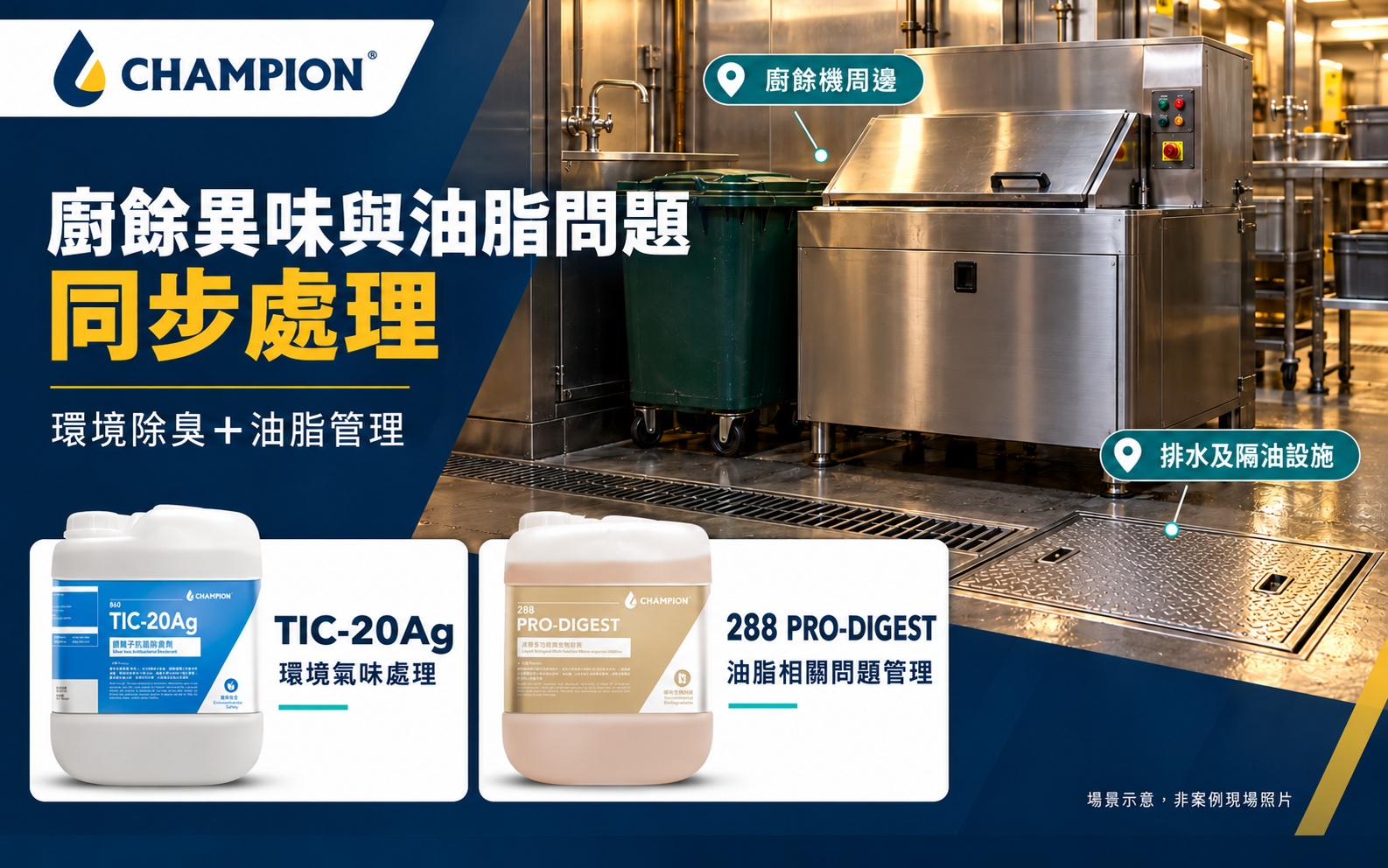
CHAMPION carried out an on-site inspection and assessment, then installed a TIC-20Ag automatic spraying system for ambient odour control around the food waste equipment, together with a 288 PRO-DIGEST Liquid Multi-Purpose Microbial Additive dosing system to treat accumulated grease. The two systems handled the corresponding tasks for ambient odours and the grease source.
Results
After installation, drain blockages, insect breeding and environmental hygiene problems improved significantly. Automatic spraying also reduced labour and routine maintenance demands. The customer reported that the related complaints no longer occurred and expressed strong satisfaction with the improved drainage and site conditions.
This case illustrates that if food waste odors are accompanied by grease and drainage issues, the treatment plan needs to cover multiple locations. For other sites, first check the area around the food waste disposer, grease traps, and drainage paths, then combine this with environmental deodorization and grease treatment. The actual dosing and spraying settings should be planned according to equipment operation and site conditions.
Case 2: combining cleaning and ambient odour control for blood-related smells during fish preparation
Background and challenges
At another five-star hotel, strong odours arose in the fish preparation room when the processing equipment was operating. The smell of blood affected staff working conditions, while the area also had to meet cleanliness and food hygiene requirements. Management wanted to improve the working environment and integrate odour control with routine cleaning.
On-site solution
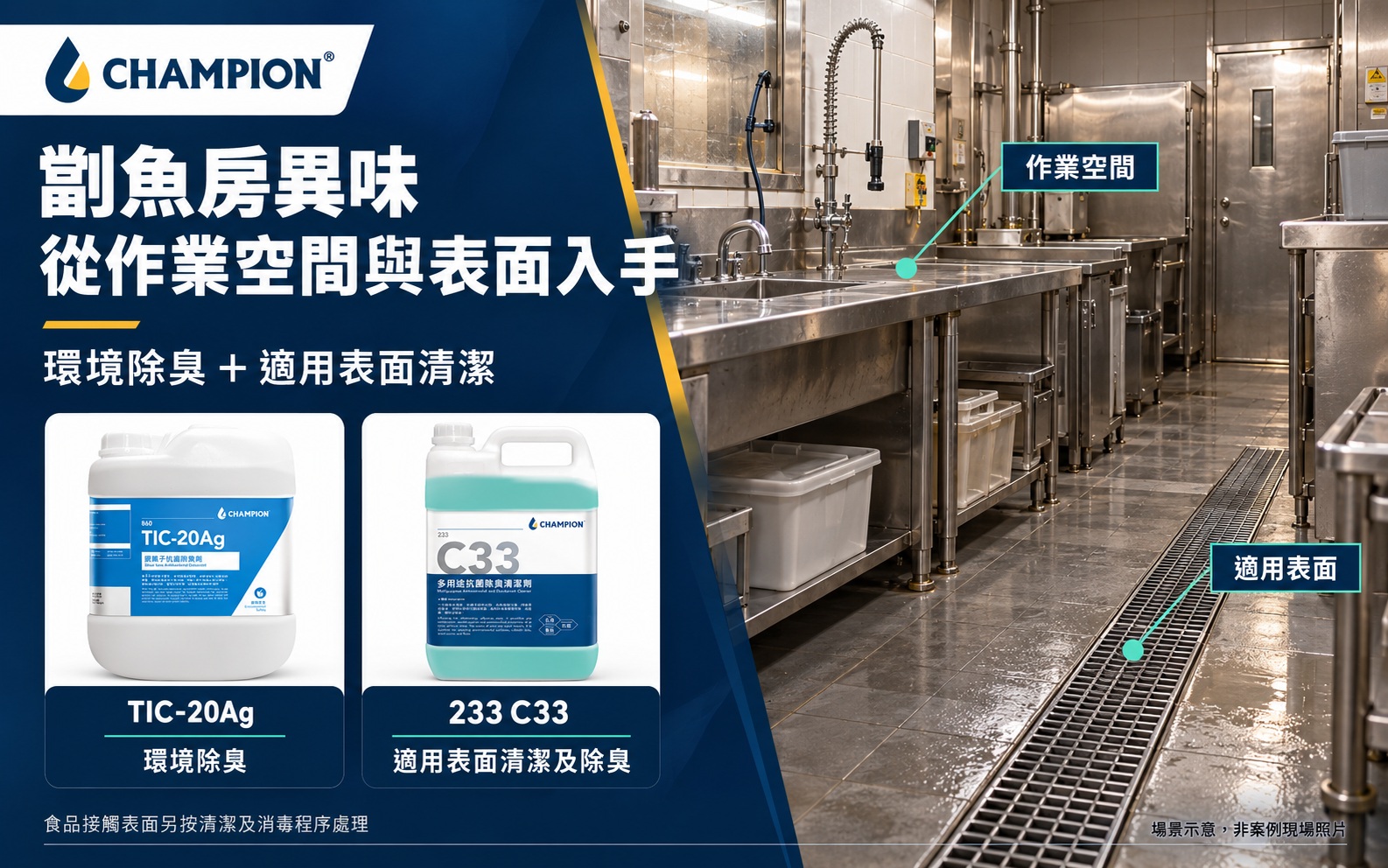
CHAMPION carried out an on-site inspection and assessment, then used a TIC-20Ag automatic spraying system alongside 233 C33 Multi-Purpose Antimicrobial and Deodorant Cleaner. TIC-20Ag supports ambient odour control, 233 C33 supports cleaning, antibacterial treatment and deodorising on suitable surfaces, addressing the workspace and surface-cleaning needs respectively.
Results
After installation, the smell of blood in the fish preparation room was largely eliminated. The environment became cleaner and staff reported a much better working experience. The customer was highly satisfied with the overall outcome.
These types of facilities allow for a seamless process of cleaning fish scraps and blood, surface cleaning, and deodorization. Cleaning and disinfection of food contact surfaces continue according to established procedures, ensuring a clear division of labor between odor control and hygiene management.
4. Maintaining odour control: routine cleaning and follow-up
To sustain odour control, CHAMPION products should be used alongside routine cleaning, food waste removal and equipment maintenance. Managers can schedule cleaning, spraying or dosing around processing volumes, busy periods and odour locations, with designated staff monitoring product stocks and equipment condition.
- 233 C33 for surface cleaning: Remove food waste promptly and clear debris and soil according to the workflow. Then follow the product instructions and use 233 C33 to clean suitable surfaces and reduce residue. Treat food contact surfaces according to the relevant cleaning and disinfection procedures.
- 288 PRO-DIGEST for grease management: Based on the site assessment and equipment settings, arrange for the addition of microbial additives to treat grease and organic dirt; at the same time, keep the grease trap clean and check the drainage. If there is backflow or abnormal drainage, follow up and repair in time.
- TIC-20Ag for ambient odour control: Spraying should be planned according to the source of odor in the work area and the time of use, and the chemical inventory, nozzles and liquid supply should be checked. If the processing volume or busy period changes, the technical team can assist in reviewing the system settings.
- PureZone® for continuous air treatment: Continue operating according to the on-site configuration and product guidelines, ensuring unobstructed airflow at the inlet and outlet, and regularly inspecting, replacing filters, and maintaining the equipment. Observe odor changes during similar operating periods and follow up on results based on employee feedback.
Ensuring continuous collaboration between the cleaning team and technical services
CHAMPION provides hygiene consultation, product selection, professional training, dosage control and ongoing monitoring. Training and follow-up can be arranged around site needs so that frontline staff understand each product’s purpose, operating requirements, replenishment method and whom to contact if problems arise.
By incorporating odor, drainage, and equipment conditions into routine inspections, the team can more easily detect changes early. If workload, food processing procedures, or site configurations are adjusted, the existing plan can be reviewed with the technical team to ensure that deodorization and cleaning arrangements continue to meet actual needs. Food hygiene and designated disinfection requirements are managed according to their respective procedures.
Frequently Asked Questions
Which should be addressed first: food waste odor or kitchen drainage odor?
First, identify the location of the odor; if both odors occur simultaneously, address them concurrently. If there is residue around the food waste bin or food waste disposer, clean it first and review the waste disposal plan; if the kitchen drainage odor is accompanied by grease buildup or slow drainage, check the drainage and grease trap facilities as well, and then assess suitable grease handling and environmental deodorization solutions.
Does reduced odour in a fish preparation room mean disinfection is complete?
Deodorization and disinfection are different processes. After the environmental odor is improved, food contact surfaces must still be treated according to applicable cleaning and disinfection procedures and product instructions; relevant hygiene requirements should also be checked using corresponding methods.
Should all four products be used?
Select products according to site needs. The food waste and fish preparation cases used different combinations. Where continuous treatment of airborne odour molecules and gaseous odour sources is needed, consider PureZone® . The final configuration should follow an on-site assessment and the products’ conditions of use.
How to maintain the deodorizing effect in a hotel kitchen?
According to site needs, combine 233 C33 surface cleaning, 288 PRO-DIGEST grease management, TIC-20Ag ambient odour control and PureZone® air treatment with food waste removal, drainage maintenance and equipment care. Use observations from comparable operating periods and staff feedback to refine cleaning procedures and system settings.
Book a hotel kitchen odour-control consultation
Start with the areas causing the greatest difficulty: odours around food waste equipment, grease buildup and poor drainage, or recurring blood-related smells in the fish preparation room. Gather site photographs, the times when problems occur and details of existing cleaning arrangements. CHAMPION can discuss suitable products and equipment for the site.
Hotel, catering and property management teams across Hong Kong Island, Kowloon and the New Territories can contact CHAMPION for a free 15-minute consultation, or use WhatsApp Instant Messaging to share site photographs, odour locations and existing cleaning arrangements, and discuss suitable treatment options and assessment methods.
Further Reading
- Persistent bathroom odors: 5 sources and solutions
- Commercial deodorizer selection: Comparison of bipolar ion, HEPA, activated carbon, and aromatherapy
Source of information
[1] Hong Kong Environmental Protection Department: guidance on managing and removing grease trap waste .
[2] Hong Kong Centre for Food Safety: Cleaning and Sanitization .
[3] CHAMPION Product Information: TIC-20Ag , 288 PRO-DIGEST , 233 C33 and PureZone® Product page; Chemical catalog and PureZone® Product catalog.