
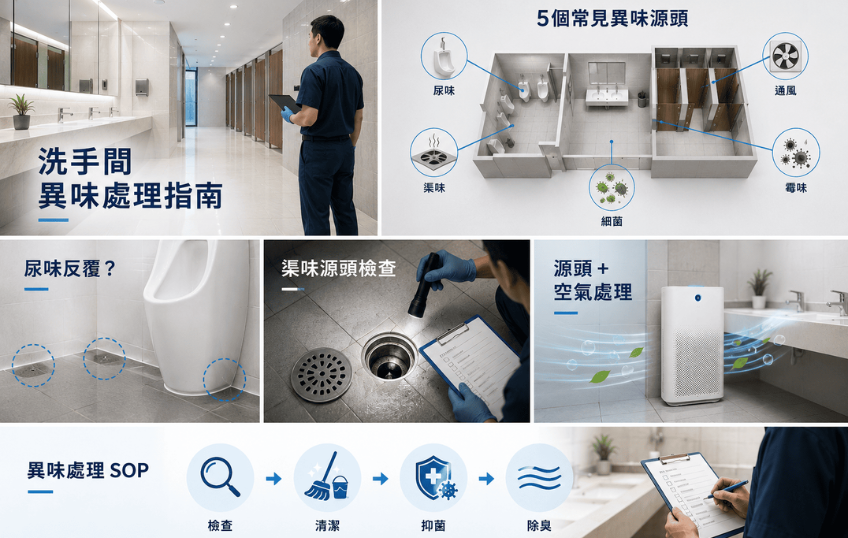
Many public restrooms in shopping malls, office buildings, schools, clubhouses and residential estates are cleaned daily, yet unpleasant odours such as urine, drain and musty smells may still persist. For property management teams, restroom odors are not just a hygiene issue; they can directly impact visitor experience, tenant satisfaction, and the number of complaints.
When unpleasant odours appear, many venues first respond by increasing cleaning frequency, spray air fresheners, or use stronger scented products. However, if the source of the odor still exists, these methods often only temporarily mask the smell and may not truly solve the problem.
To effectively eliminate bathroom odors, the key is not to "spray enough fragrance," but to find the source and then combine it with cleaning, antibacterial, deodorizing, and air treatment solutions.
5 common sources of bathroom odor
1. Accumulation of urine residue and ammonia
One of the most common unpleasant smells in restrooms is urine. Urine stains tend to accumulate in men's restrooms, urinals, the bottom of toilets, the edges of the floor, and the base of walls due to long-term use.
When urine remains on surfaces or in crevices, it can decompose and produce a pungent ammonia odor. This odor can sometimes recur even with daily mopping because ordinary surface cleaning may not be able to thoroughly remove the odor molecules hidden in corners, crevices, and sources of pollution.
In response to such situations, in addition to strengthening the cleaning of the floor and the area around the urinals, the property management team can also consider using treatment solutions with deodorizing and antibacterial functions, such as... TIC-20Ag Sliver Ions Antibacterial DeodorantIt helps address the source of odors, rather than simply masking them with fragrance.
2. Odors coming from underground drains, water outlets, and drainage systems.
If there is a noticeable drain smell in the bathroom, the problem may not be from the ground, but may be related to the drain, water level, or drainage system.
Common causes include:
- The drainage ditch is dry and its air-sealing function is insufficient.
- Dirt and grime can accumulate in water levels
- Stains accumulate near the drain outlet for a long time
- Dead corners were not cleaned regularly.
- Aging drainage system or poor ventilation
These types of odors usually don't disappear with air fresheners or diffusers; instead, you need to check the drains, sewers, and drainage systems. For public restrooms in shopping malls, office buildings, or residential complexes, it is recommended to regularly inspect the drains and perform deep cleaning to prevent the odors from recurring.
If the odor is not only coming from the bathroom surface, but is related to the sewer, drainpipe, or grease trap, an extended site assessment may be considered. 288 PRO-DIGEST Liquid Multi-Purpose Microbial Additive Solutions for odor control in drainage pipes and at the source.

3. Bacterial growth causes the odor to recur.
Bathrooms are often damp, and with high traffic and frequent use, they are ideal environments for bacterial growth. When bacteria decompose urine stains, sewage, garbage can residue, or other organic pollutants, they can continuously release unpleasant odors.
This also explains why some restrooms start to smell again shortly after cleaning. The problem isn't necessarily that the cleaners didn't clean properly, but rather that the odor-causing bacteria continue to thrive in damp areas, crevices, or near trash cans.
For daily cleaning, consider using... 233 C33 Multi-Purpose Antimicrobial and Deodorant CleanerIt is used for cleaning hard surfaces, floors, trash cans, and sanitary wares in restrooms, helping to remove stains, bacteria, and odors. It can also be used in conjunction with other products to address persistent odors. TIC-20Ag Sliver Ions Antibacterial DeodorantStrengthen source deodorization and antibacterial management.
4. Insufficient ventilation causes odors to linger for extended periods.
Some restrooms may appear clean on the surface, yet still have a musty smell due to poor ventilation and insufficient airflow.
For example:
- The restroom space is relatively enclosed
- Insufficient exhaust fan efficiency
- Heavy foot traffic allows odours to build up quickly.
- Poor air circulation causes odor molecules to linger for extended periods.
- Moisture was not quickly removed after cleaning.
In this situation, simply cleaning the floor may not be enough, as some of the odor may remain in the air. Commercial restrooms that require maintaining good air quality for extended periods could consider introducing [a system/mechanism]. PureZone Bipolar Ion Air PurifierCombined with bipolar ion and HEPA filtration technology, it helps to deal with odor molecules and particulate matter in the air.
5. Damp, musty smell and stains in tile grout
Bathrooms that are consistently damp, poorly ventilated, or have many hard-to-clean areas are prone to developing a musty smell. Mold doesn't only appear in obvious places; it can also hide in:
- Tile grout
- foot of a wall
- ceiling
- bottom of the sink
- Door edge and rubber edge
- Long-term damp location
The smell of mildew is different from the smell of urine; it usually has a damp, musty, and unpleasant feel. Relying solely on aromatherapy cannot eliminate the source of mold and may even make the air smell more mixed.
If mold problems are found on the walls, tile grout, or ceiling, cooperation can be considered. 207 CU-7 Multipurpose Stain RemoverIt is used to treat mold, hard surface stains, and tile grout.
Why can't air fresheners really solve bathroom odors?
When faced with unpleasant odors in restrooms, many venues will first use aromatherapy diffusers, air fresheners, or air fresheners. These products can improve the olfactory experience in the short term, but in essence, most of them simply mask the odour and do not address the source of the smell.
Once the fragrance dissipates, the smells of urine, sewer drains, mold, or bacteria will reappear. Sometimes, the mixture of fragrance and stench can make the bathroom smell even more pungent, and visitors may even find the fragrance "unnatural."
For commercial restrooms, the ideal direction should be:
- First, find the source of the odor.
- Further treatment of surface stains and bacteria
- Simultaneously improve odors in the air
- Finally, establish a regular inspection and maintenance process.
Simply put, dealing with bathroom odors shouldn't just rely on "adding fragrance," but rather requires... Source treatment + antibacterial cleaning + air deodorization.
If the venue is considering using ozone generators, air fresheners, or other air treatment equipment, it's advisable to first understand the applicable scenarios and safety limitations of different technologies:Angel or devil? A comprehensive analysis of ozone technology.

How should odors in commercial restrooms be dealt with?
Step 1: Find the source of the odor
Before addressing bathroom odors, it is recommended to check the following areas:
| Inspection Area | FAQ |
| urinal | Urine stains, ammonia odor, and unpleasant smell from the drain. |
| bottom of toilet | Stains buildup, hard-to-clean areas |
| Floor edges | Urine seeps in and is difficult to clean completely by mopping. |
| Drainage | Drainage odor, insufficient ventilation, and accumulation of dirt and grime |
| garbage can | Paper towels, sewage, and bacteria growth |
| bottom of the sink | Dampness, musty smell, and odor from the drain |
| Wall and tile grout | Mold, moisture, and stains build up |
| exhaust port | Insufficient ventilation and lingering odors |
If you don't first determine the source of the odor, and simply keep cleaning or spraying fragrance, the problem is likely to recur.
Step 2: Treating surface stains and daily cleaning
Routine cleaning of restrooms should target high-touch areas, hard surfaces, floors, trash cans, and sanitary ware. In addition to removing surface stains, antibacterial and deodorizing effects should also be considered.
233 C33 Multi-Purpose Antimicrobial and Deodorant Cleaner It can be used as a daily cleaning aid, suitable for hard surfaces such as bathroom floors, walls, ceramics, glass, doors and windows, sanitary ware, and trash cans, to help maintain public environmental hygiene.
Step 3: Inhibit bacteria and decompose the source of odor
If your bathroom has a persistent odor from urine, garbage cans, or bacteria, regular cleaning alone may not be enough. In this case, consider incorporating source-addressing and antibacterial solutions.
TIC-20Ag Sliver Ions Antibacterial Deodorant It can be used in places like restrooms and garbage rooms where persistent odors are likely to occur, helping to deal with odor molecules and odor-causing bacteria, making it more suitable as part of source control.
Step 4: Dealing with odor molecules in the air
Air treatment is equally important when restrooms are poorly ventilated, have high traffic, or where odors tend to linger. Even after floor cleaning, urine, sewer, or other unpleasant odor molecules may still remain in the air.
PureZone Bipolar Ion Air Purifier It can be used in commercial spaces that require long-term air management. Through the combination of bipolar ion and HEPA filtration, it helps to deal with odor and particulate problems in the air. It is suitable for assessment and use in restrooms, tea rooms, garbage rooms or other spaces where odors are concentrated.

Recommendations for handling different commercial restroom scenarios
| Scene | FAQ | Suggested approach |
| shopping mall restrooms | High foot traffic, persistent urine odor, numerous complaints | Daily cleaning + source deodorization + air purification |
| office building restrooms | Insufficient ventilation and lingering odors | Enhance air deodorization and perform regular deep cleaning. |
| school restrooms | Frequent use, high hygiene requirements | Antibacterial and deodorizing + safe cleaning solution |
| Hotel/Club restrooms | Impact on customer experience and brand image | Long-lasting deodorization + high-standard maintenance |
| public restrooms in the housing estate | Repeated complaints, many hard-to-clean areas | Establish inspection and odor control SOPs |
The sources of odors vary from place to place, so the treatment methods should not be the same. Property management companies or cleaning contractors can first develop a suitable odor treatment plan based on the flow of people, ventilation, odor sources, and cleaning frequency of the site.
If the venue is a residential estate, commercial building, shopping mall, or public facility, you can also refer to Champion's [resources/services]. Property Management Cleaning and Hygiene SolutionsAppropriate cleaning and odor control solutions should be planned according to the needs of different public spaces.
Bathroom Odor Removal FAQ
Does the smell of urine in the bathroom indicate inadequate cleaning?
Not necessarily. A urine smell in the bathroom can be related to urine stains, gaps in the floor, urinals, drains, bacterial growth, or poor ventilation. Even with daily cleaning, the odor may recur if the source is not addressed.
Can air fresheners really eliminate odors?
Most air fresheners can only mask odors for a short time and may not be able to break down odor molecules or eliminate the source of bacteria. If bathroom odors persist, a comprehensive approach should be taken, addressing cleaning, antibacterial measures, drainage issues, and air circulation.
How should we deal with the odor in the toilet drain?
Bathroom drain odors are usually related to drains, drain outlets, vents, or the drainage system. It is recommended to first check whether the drains are dry, whether the drain outlets are clogged with dirt, and whether there is any backflow of odor from the drainage system, and then carry out appropriate cleaning and maintenance.
Are deodorizing machines suitable for commercial restrooms?
Suitable for commercial restrooms, especially those with high foot traffic, poor ventilation, or where odors tend to linger. However, since deodorizers primarily address odors in the air, they should be used in conjunction with source cleaning and antibacterial solutions for a more comprehensive effect.
What's the difference between bathroom deodorizers and air purifiers?
DeodorizerIt mainly targets the source of odor, such as urine smell, garbage can odor, and bacterial growth;air purifierThis primarily addresses odor molecules and particles in the air. For commercial restrooms, the two can work together to create a more effective odor management solution.
Related products and solutions
- TIC-20Ag Silver Ion Antibacterial Deodoriser
- PureZone Bipolar Ion Air Purifier
- 233 C33 Multi-Purpose Antimicrobial and Deodorant Cleaner
- 207 CU-7 Multipurpose Stain Remover
- 288 PRO-DIGEST Liquid Multi-Purpose Microbial Additive
- 820 UDR Biological Urinal Drain Relief
- BLUEWAVE Centralised Building Toilet Flushing Water Treatment Additive
- Property Management Cleaning and Hygiene Solutions
In conclusion, bathroom odors should be addressed at their source, not just masked with fragrance.
Recurring bathroom odors are often not caused by a single factor, but rather by a combination of issues such as urine stains, sewer smells, bacteria, poor ventilation, and damp, musty odors. Relying solely on air fresheners or frequent surface cleaning may not truly solve the root cause of the odor.
For property management companies, shopping malls, schools, hotels, clubs and cleaning contractors, the ideal approach is to first conduct an on-site assessment to identify the source of the odor, and then implement a solution that includes daily cleaning, source deodorization, antibacterial treatment and air purification.
Champion can provide suitable odor control recommendations for commercial restrooms and public spaces based on different site conditions. Whether it's... Property Management Cleaning and Hygiene SolutionsWhether it's restroom deodorization, source sterilization, or air purification solutions, we can assess the needs of each site to help reduce odor complaints and improve environmental hygiene and user experience.
Want to improve odor problems in restrooms/commercial spaces?
Contact us to learn how Champion can provide suitable odor control solutions for your commercial spaces.
Free on-site assessments are available in Hong Kong.
📞 Phone:
+852 5622 2387
✉️ Email:
enquiry_hk@champion-chem.com