
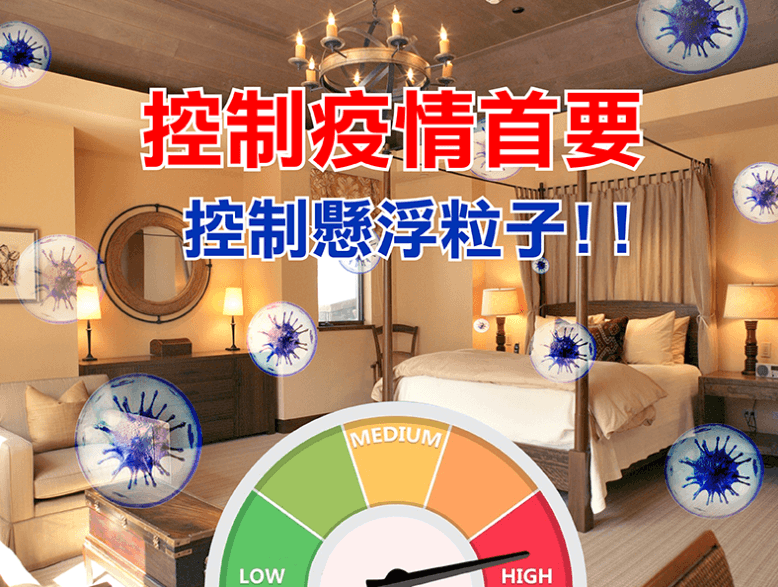
The COVID-19 pandemic continues to rage, with even the recently dormant Delta variant of the virus resurfacing! Multiple infection cases have recently broken out in Hong Kong's quarantine hotels, with suspected insufficient ventilation in the rooms leading to cross-infection. Experts have recommended that quarantine hotels install air purifiers in each room and update ventilation guidelines. Indoor air consultant Wong King-chung believes that in addition to installing purifiers, attention should also be paid to their placement and regular monitoring of indoor air quality to ensure its effectiveness.
Controlling infection risk first requires controlling the amount of suspended particles
Many people want to know how to define or ensure the best indoor air quality. Indoor air consultant Wong King-sung points out that particulate matter (PM) refers to solid particles or droplets suspended in the air, and is one of the main sources of air pollution. Viruses can also be transmitted through the air by attaching to these particles. He states that numerous authoritative studies have indicated that viruses are mainly transmitted through respiratory droplets, but can also be transmitted through contact. Therefore, controlling the number of particulate matter in indoor air is one of the effective ways to control the risk of infection.
Indoor air quality index
| Indoor air quality | Number of suspended particles | Carbon dioxide concentration (ppm) | airborne transmission risk | Health risks |
| Low | 100,000 or more | 1,200 or more | high | high |
| generally | 60,000 – 99,999 | 1,000 – 1,199 | middle | Low to Medium |
| good | 10,001 – 59,999 | 801 – 999 | Low | Extremely low |
| excellent | 10,000 or less | 800 or below | Extremely low to low | Extremely low |
Huang Jinsong pointed out that in poorly ventilated rooms, the number of viruses in the air will accumulate. By monitoring indoor air quality or using carbon dioxide concentration to control ventilation, the chance of virus transmission can be effectively reduced.
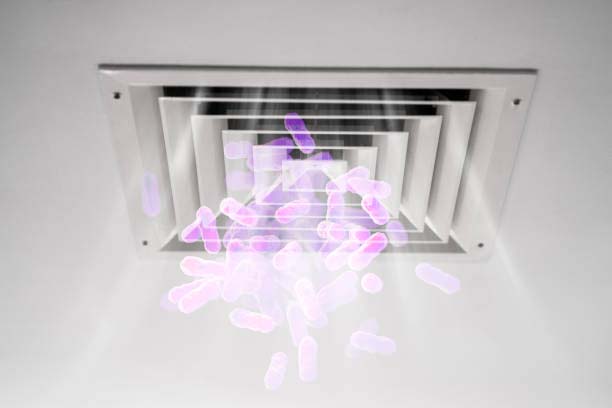
If ventilation systems are not regularly maintained, dust and suspended particles can accumulate, making them a breeding ground for viruses.
The location of the air purifier is crucial.
He also pointed out that many people believe that installing an indoor air purifier is a one-time solution, but they often overlook the placement of the purifier. Below are his suggestions for suitable and unsuitable placement locations for air purifiers:
|
should |
avoid |
| Air purifiers should be placed as close as possible to users so that they can always breathe the cleanest air. | Air purifiers should not be placed near the entrance, as clean air can easily escape. |
| Air purifiers can be placed near windows to filter out stale air blown into the room immediately. | Air purifiers should not be placed in high positions, as they have a higher chance of inhaling harmful suspended particles. |